Sex is more than just physical connection; it’s about agency, confidence, and protection. While the “standard” latex condom has been the go-to for decades, there is another powerful tool in the sexual health toolkit that is often overlooked: the female condom, also known as the internal condom.
If you’ve ever found yourself asking, “What is a female condom?” or wondered if it’s as reliable as other methods, you are in the right place. In this deep-dive guide, we are breaking down the science, the steps, and the real-world benefits of this game-changing barrier method.
1. What Is a Female Condom? Beyond the Basics
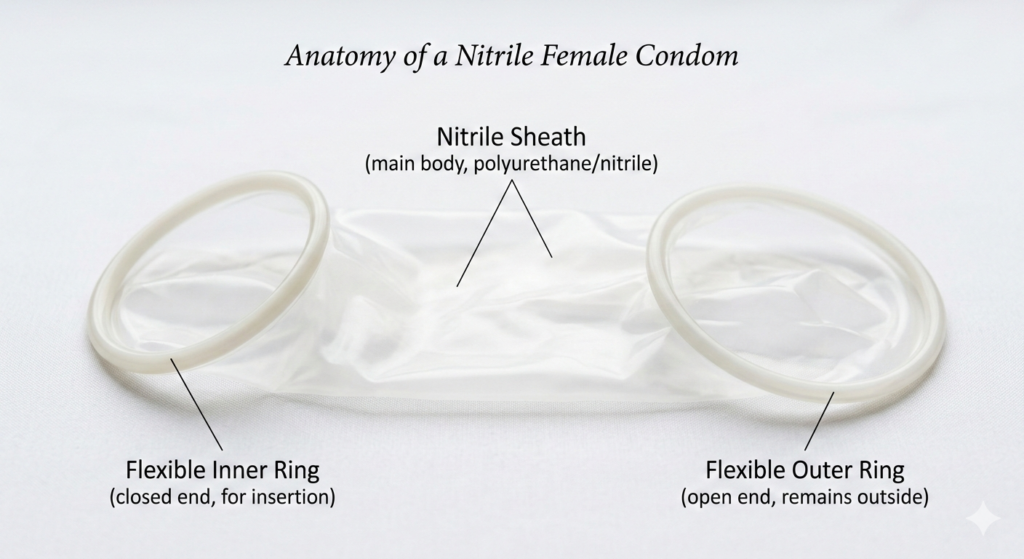
To truly understand your options, let’s start with the definition. What is a female condom? It is a thin, flexible, lubricated pouch designed to line the inside of the vagina (or anus) during sexual activity.
Unlike the external (male) condom, which fits snugly over a penis, the internal condom features a dual-ring system:
- The Inner Ring: Made of flexible material, this ring is inserted deep into the vagina to hold the condom in place against the cervix.
- The Outer Ring: This remains outside the body, covering a portion of the vulva and providing an extra layer of protection against skin-to-skin STI transmission.
Material Science: Why It Matters
Most modern female condoms, like the widely recognized FC2, are made of Nitrile (synthetic rubber). This is a massive win for sexual health for two reasons:
- Latex-Free: It is 100% safe for anyone with latex allergies or sensitivities.
- Heat Transfer: Nitrile conducts body heat much more efficiently than latex. This means the material warms up to your body temperature (roughly 37°C) almost instantly, significantly reducing that “plastic barrier” feeling and enhancing natural sensation.
2. Female Condom Effectiveness: The Real Numbers
When it comes to birth control, reliability is everything. Let’s look at the data regarding female condom effectiveness. According to clinical studies from organizations like the CDC and the Guttmacher Institute, effectiveness is measured in two ways:
Perfect Use vs. Typical Use
- Perfect Use (95% Effective): This means using the condom correctly every single time, with no slips, tears, or incorrect insertions. Under these conditions, only 5 out of 100 people will become pregnant in a year.
- Typical Use (79% – 82% Effective): This accounts for real-life human error—forgetting to use one, inserting it incorrectly, or the penis accidentally sliding between the condom and the vaginal wall.
Why It’s a Powerhouse for STI Prevention
While its pregnancy prevention rate is slightly lower than the pill or male condoms, the internal condom excels at preventing STIs (Sexually Transmitted Infections). Because the outer ring covers part of the vulva, it provides a physical barrier against infections passed through skin-to-skin contact, such as HPV (Human Papillomavirus) and Genital Herpes, which standard condoms might miss.
3. Internal vs. External Condoms: A Side-by-Side Comparison
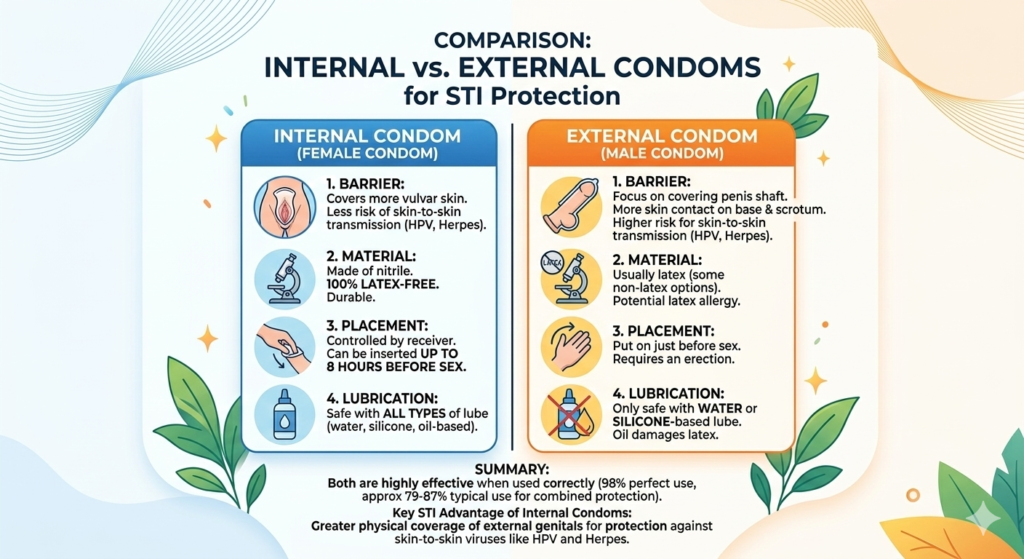
If you are deciding which method to stock in your nightstand, this comparison table will help you choose:
| Feature | Female (Internal) Condom | Male (External) Condom |
| Material | Nitrile or Polyurethane (Latex-Free) | Usually Latex (Some non-latex options) |
| Insertion Time | Up to 8 hours before sex | Only when the penis is erect |
| Lubricant Choice | Safe with Water, Oil, and Silicone-based | Water-based only (Oil destroys latex) |
| Placement | Inside the vagina or anus | Over the penis |
| Control | Controlled by the person receiving | Controlled by the person giving |
The “Spontaneity” Factor
One of the biggest complaints about male condoms is that they “kill the mood” because you have to stop and put them on. The female condom solves this. Since you can insert it hours in advance, there is zero interruption when things get steamy.
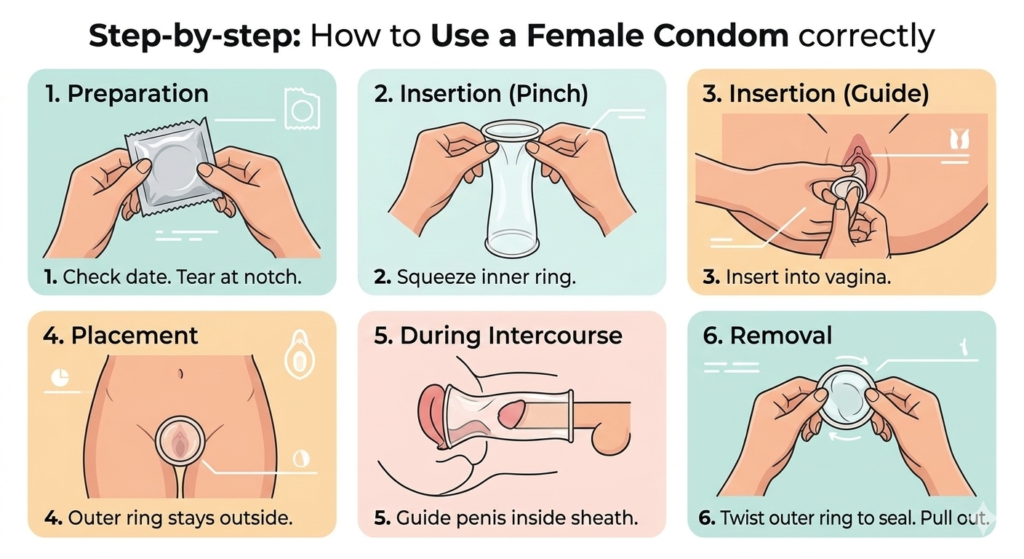
4. How to Use a Female Condom: A Step-by-Step Guide
If you can use a tampon or a menstrual cup, you can master this. Here is exactly how to use a female condom like a pro.
Step 1: The Inspection
Check the expiration date. Squeeze the package to ensure there’s an air bubble—this proves the seal hasn’t been punctured.
Step 2: Get Into Position
Find a comfortable spot. You might want to squat, put one leg up on the toilet, or lie down with your knees bent.
Step 3: The Squeeze
Apply a drop of lubricant to the outside of the closed end (the inner ring). Squeeze the inner ring between your thumb and middle finger so it becomes long and narrow.
Step 4: Insertion
Gently push the squeezed ring into the vagina. Use your index finger to slide the condom up as far as it will go. You should feel it rest against your cervix. The outer ring should hang about an inch outside the body.
Step 5: During the Act
Guide the penis or sex toy into the center of the condom. If you feel it slip between the condom and the vaginal wall, stop and readjust!
Step 6: Removal
Twist the outer ring to seal the fluids inside, then gently pull it out. Wrap it in a tissue and toss it in the bin (never flush it!).
5. Real User Stories: Living with the Choice
“The Latex-Free Lifesaver” — Sarah, 28 “I struggled for years with ‘mystery’ irritation after sex. It turned out I had a mild latex allergy. Switching to internal condoms was a revelation. No more itching, and I love that I’m the one in charge of the protection.”
“Perfect for Long-Distance” — Marcus & Elena “When we see each other after weeks apart, we don’t want to wait. Elena puts the condom in before I even get from the airport to her apartment. It makes our time together feel much more natural.”
6. Deep-Dive FAQ: Your Questions Answered
Can a female condom get lost inside me?
No. Your cervix acts as a physical wall. The condom can bunch up or slide in slightly, but it cannot travel into your uterus or anywhere else in your body. If it slides in, simply reach in with your fingers and pull it out by the ring.
Does it make a noise?
Sometimes, if there isn’t enough lubrication, you might hear a slight “rustling” or “clicking” sound. Pro-tip: Add a few drops of water-based or silicone lubricant inside the condom before sex to make it silent and more comfortable.
Can I use it for anal sex?
Yes. Internal condoms are frequently used for anal sex. Simply remove the inner ring if it feels uncomfortable, and ensure you use plenty of lubricant, as the rectum does not produce its own moisture.
Can I use it with a male condom?
Never. This is a common mistake. Using two condoms together (double-bagging) creates friction that makes both more likely to tear. Pick one and stick with it!
7. Final Thoughts: Putting Your Health First
The female condom is more than just a piece of nitrile; it is an instrument of autonomy. Whether you are managing a latex allergy, looking to prevent STIs more effectively, or simply wanting to take the lead in your sexual health, it is a brilliant and reliable option.
Ready to try it? Our best advice is to practice once or twice while you are alone and relaxed. Once you get the “hang” of the insertion, it becomes a seamless part of your routine.