

Everything is fine. Actually, more than fine — your partner is kind, they show up, they tell you they love you. And yet.
You lie awake replaying a conversation from three days ago, wondering if something you said sounded wrong. You notice they took an hour to reply to a text and spend the next forty minutes constructing possible explanations, most of them bad. You catch yourself scanning their face during dinner for signs that something has shifted. You ask, for the fourth time this week, whether they’re sure they’re happy — and you can see, in their pause before answering, that the question itself is becoming a problem.
This is what relationship anxiety looks like from the inside. Not drama, not distrust — just a mind that will not quiet down, in a relationship that has not actually given it a reason to spiral.
Relationship anxiety is one of the most common and least discussed forms of anxiety. It can exist in relationships that are, by any external measure, healthy and loving. And left unaddressed, it can gradually erode the very connection it is so afraid of losing.
Key Takeaways
- Relationship anxiety is the persistent experience of worry, doubt, and insecurity within a romantic relationship — even when the relationship is functioning well and the partner is not doing anything to warrant concern.
- It is distinct from intuition or a healthy response to genuine red flags. The distinguishing feature is that the anxiety is internally generated, driven by patterns of thought rather than by the partner’s actual behaviour.
- Anxious attachment — a relational pattern rooted in early experiences — is one of the most significant contributors to relationship anxiety and affects an estimated 19–20% of the population, according to research published in Attachment & Human Development.
- Relationship OCD (ROCD) is a clinically recognised variant of OCD in which obsessive doubts centre specifically on romantic relationships. It is frequently misidentified as relationship anxiety and requires different treatment.
- Cognitive behavioural therapy (CBT) and Emotionally Focused Therapy (EFT) have the strongest evidence bases for treating relationship anxiety. Self-directed strategies — including mindfulness, communication practice, and self-compassion — are meaningful complements but rarely sufficient as standalone approaches for significant anxiety.
What Is Relationship Anxiety
Relationship anxiety is the experience of persistent worry, doubt, or unease about a romantic relationship — regardless of whether the relationship itself is actually in difficulty. The anxiety is characteristically self-generated: it arises from internal patterns of thought and emotion rather than from the partner’s behaviour or the relationship’s actual circumstances.
This distinction is important. Concern about a relationship in which there are genuine problems — dishonesty, inconsistency, disrespect — is not relationship anxiety. It is appropriate responsiveness to real information. Relationship anxiety, by contrast, produces fear and doubt in circumstances that do not warrant them. The relationship is good. The partner is present and invested. And the anxious mind still finds a way to be afraid.
People with relationship anxiety often describe a specific, exhausting quality to their experience: the feeling of watching themselves spiral and being unable to stop, even when they know — intellectually — that the fear is disproportionate to reality. The knowing and the feeling coexist without resolving each other.
Relationship Anxiety Symptoms: What It Actually Looks Like
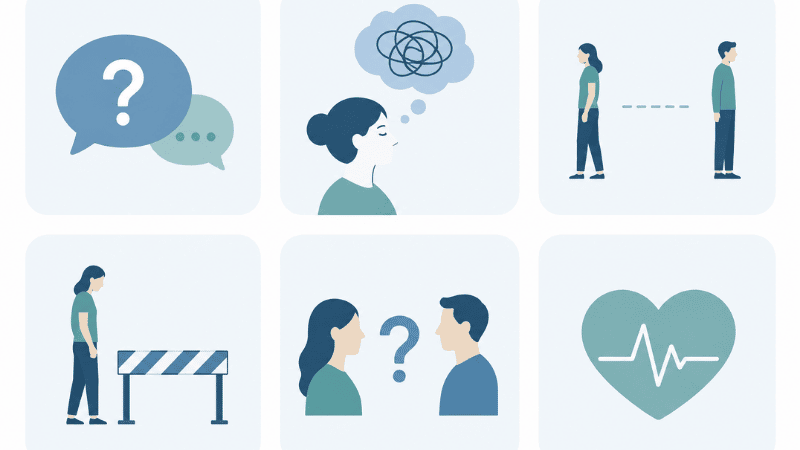
Recognising relationship anxiety in yourself is harder than it sounds, because the experience feels internally coherent — like reasonable concern, not anxiety. The thoughts feel like perception, not distortion. Some of the most common presentations:
Constant reassurance-seeking — asking your partner repeatedly whether they are happy, whether they still love you, whether something is wrong. Each reassurance provides temporary relief before the doubt reasserts itself.
Interpreting neutral behaviour as threatening — reading a slow text reply, a quiet evening, or a moment of distraction as evidence that something has changed. Building elaborate interpretations from genuinely neutral information.
Overthinking conversations — replaying interactions hours or days later, looking for things you said that could have landed badly, wondering what your partner actually meant by something they said.
Fear of abandonment that feels urgent — a persistent, low-level dread that the relationship will end, often without a specific trigger. The fear can intensify around milestones, arguments, or any moment of perceived distance.
Self-sabotaging behaviours — picking arguments over small things, withdrawing emotionally before the anticipated rejection, testing the relationship in ways that create the instability you were afraid of.
Comparison and compatibility doubt — wondering whether you chose the right person, comparing your relationship to others’, catastrophising about whether you are fundamentally compatible for the long term.
Physical symptoms — anxiety in relationships has a physical dimension: the racing heart when you see a message notification, the tightness in the chest during a small disagreement, the inability to sleep when something feels unresolved.
The editor’s honest observation: the experience of relationship anxiety is often described by the people who have it as deeply embarrassing. They know how it looks. They have been told — sometimes by partners, sometimes by their own internal critic — that they are too much, too needy, too insecure. This shame compounds the anxiety. It is worth saying clearly: relationship anxiety is a recognizable clinical pattern with identifiable causes and effective treatments. It is not a character flaw.
Anxious Attachment Relationship: The Deeper Pattern
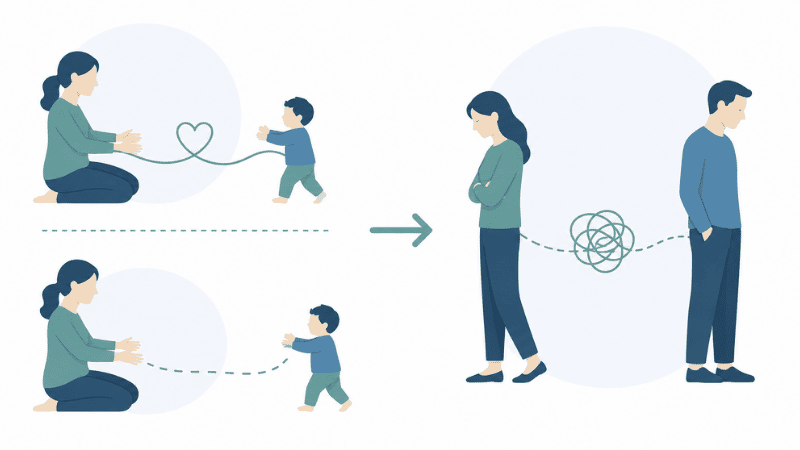
To understand relationship anxiety, it helps to understand the attachment system — the neurobiological framework that governs how we seek closeness, manage distance, and respond to perceived threats to our close relationships.
Attachment styles develop in early childhood through repeated interactions with primary caregivers. When caregivers are reliably available and responsive, children develop what is called secure attachment — an internalized sense that relationships are safe and that they are worthy of love. When caregivers are inconsistently available — sometimes warm and present, sometimes distant or unpredictable — children develop anxious attachment: a hypervigilant orientation toward relationship cues, an elevated fear of abandonment, and a deep uncertainty about whether they are loveable.
Anxious attachment does not simply disappear in adulthood. It transfers — often very precisely — into romantic relationships. The same hypervigilance that monitored a parent’s availability now monitors a partner’s. The same fear of abandonment that arose when a caregiver was unavailable now arises when a partner is quiet, busy, or distracted. The same reassurance-seeking that soothed childhood anxiety now plays out in romantic partnerships, often in ways that create friction.
This is not destiny. Attachment styles are not fixed — they are patterns that can shift through insight, intentional practice, and particularly through the experience of a consistently secure relationship. But understanding that relationship anxiety often has roots in attachment history shifts the work from “fixing” the anxiety to understanding where it comes from and building a different relationship with it.
Relationship OCD vs Relationship Anxiety: An Important Distinction
Relationship OCD (ROCD) is a clinically recognised subtype of obsessive-compulsive disorder in which obsessive doubts centre on romantic relationships. It is frequently confused with relationship anxiety — the presentations can look similar from the outside — but the underlying mechanism is different, and the treatment approaches diverge.
In relationship OCD, the person experiences intrusive, unwanted thoughts about the relationship — often taking the form of “What if I don’t really love them?”, “What if they’re not the right person?”, or “What if I’m only staying because I’m afraid to leave?” These thoughts feel ego-dystonic — deeply at odds with the person’s actual values and desires — and produce significant distress. The person then engages in compulsive behaviours (repeated checking, seeking reassurance, mental reviewing) to try to neutralise the thought, which temporarily reduces distress but reinforces the OCD cycle.
The critical distinguishing feature is the intrusive, unwanted quality of the doubt. In relationship anxiety, the person is genuinely worried about things they care about. In ROCD, the doubt is experienced as an intruder — a thought the person does not want and that does not reflect their actual feelings about their partner or relationship.
If your doubts feel ego-dystonic — if you feel like your mind is lying to you, and you are distressed by the doubt itself rather than by what the doubt might mean — ROCD is worth exploring with a clinician who has specific OCD expertise. The first-line treatment for ROCD is Exposure and Response Prevention (ERP), which is distinct from the approaches used for relationship anxiety.
How to Deal with Relationship Anxiety: Evidence-Based Approaches
Identify the Pattern, Not Just the Trigger
Relationship anxiety tends to attach to whatever is available — a slow reply, a cancelled plan, a quiet evening. The trigger is less important than the underlying pattern. A useful first step is mapping your anxiety: when does it spike? What thoughts accompany it? What behaviours does it produce? What temporary relief do you seek?
This mapping, ideally done in writing, moves relationship anxiety from a felt experience to an observable pattern — which makes it workable rather than simply overwhelming.
If you only have 10 minutes: When you notice the anxiety rising, write down three things: what triggered it, what your mind is saying (the specific thought), and what the evidence actually says. This is not about talking yourself out of the anxiety — it is about creating a small amount of distance between the feeling and the story the feeling is telling.
Practice Tolerating Uncertainty Without Seeking Reassurance
Reassurance-seeking is one of the most common — and most counterproductive — responses to relationship anxiety. It feels like it should help: you ask your partner whether they are happy, they say yes, you feel better. But the relief lasts minutes to hours before the doubt reasserts itself, often stronger than before. Each cycle of doubt-reassurance-temporary relief-doubt reinforces the anxiety rather than reducing it.
Building tolerance for uncertainty — the capacity to sit with not-knowing without immediately seeking to resolve it — is one of the core skills in addressing relationship anxiety. This is genuinely uncomfortable, particularly early on. The goal is not to suppress the anxiety but to reduce the compulsive response to it.
Specific practice: when you feel the urge to seek reassurance, name it (“I want to ask for reassurance right now”), wait twenty minutes, and do something else. Note whether the urgency reduces. It usually does — not because the doubt is resolved, but because the peak of anxiety is temporary.
Communicate About the Pattern, Not Just the Content
One of the most important relational moves available to people with relationship anxiety is bringing their partner into the experience — not by seeking reassurance, but by sharing the pattern itself.
“I’ve noticed I get anxious when there’s any distance between us, even when everything is fine. I’m working on it. I want you to know it’s not about you.” This is categorically different from “Are you sure you’re happy with me?” The first invites partnership in understanding an internal experience. The second puts the partner in the position of managing the anxiety through repeated reassurance.
Partners who understand the pattern — who know that a quiet evening does not mean something is wrong, who can say “I notice you seem anxious tonight” without it becoming a confrontation — are significantly more able to provide the kind of consistent, predictable responsiveness that gradually builds security.
→ Related: How to Communicate in a Relationship: A Practical Guide
Develop a Self-Compassion Practice
Relationship anxiety is exhausting. It is exhausting to live in, and it is exhausting to feel ashamed of. Self-compassion — the capacity to treat yourself with the same understanding you would extend to a friend experiencing the same thing — reduces the layer of secondary suffering (shame, self-criticism, self-blame) that compounds primary anxiety.
Research by Dr. Kristin Neff consistently demonstrates that self-compassion is associated with greater emotional resilience, lower anxiety, and — perhaps counterintuitively — greater ability to change behaviour, because it removes the shame that makes honest self-examination feel threatening.
If you have tried these approaches and they are not helping: Self-directed strategies have real value, but they have limits. Significant relationship anxiety — anxiety that is affecting your daily functioning, your relationship quality, or your sense of wellbeing — warrants professional support. This is the signal to seek therapy, not to try harder on your own.
Relationship Anxiety Therapy: What the Evidence Supports
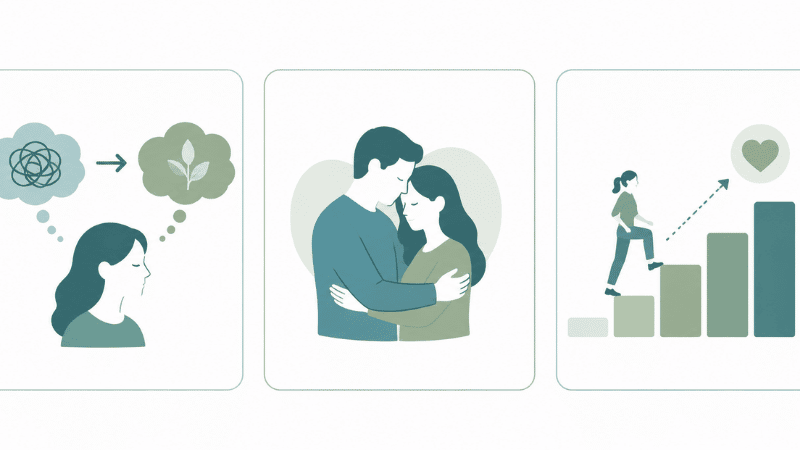
Therapy is the most effective intervention for significant relationship anxiety. Two approaches have the strongest evidence bases:
Cognitive Behavioural Therapy (CBT) — addresses the thought patterns that drive relationship anxiety directly. CBT helps identify cognitive distortions (catastrophising, mind-reading, all-or-nothing thinking) and develop more accurate, flexible ways of interpreting relationship events. It also includes behavioural components — particularly reducing reassurance-seeking and building tolerance for uncertainty.
Emotionally Focused Therapy (EFT) — developed specifically for couples, EFT addresses the attachment patterns underlying relationship anxiety at the level of the relationship dynamic rather than the individual. It helps partners understand each other’s emotional responses and create the cycles of secure responsiveness that gradually build felt security. EFT is particularly effective when the anxious attachment pattern is significantly affecting the relationship dynamic.
For ROCD specifically, Exposure and Response Prevention (ERP) — a structured form of CBT for OCD — is the first-line treatment.
Individual therapy is appropriate when the anxiety is primarily an individual pattern. Couples therapy is appropriate when the pattern is significantly affecting the relationship dynamic, or when both partners would benefit from understanding and responding to the anxiety together.
Warning Signs: When to Seek Professional Support
The following warrant clinical attention rather than continued self-management:
- Relationship anxiety that is causing significant distress or affecting daily functioning — work, sleep, concentration
- A pattern of anxiety that has persisted across multiple relationships, suggesting a systemic rather than situational pattern
- Anxiety that is producing behaviours that are damaging the relationship — frequent conflict, emotional withdrawal, compulsive reassurance-seeking
- Intrusive, ego-dystonic doubts that feel like thoughts you do not want — which may indicate ROCD rather than relationship anxiety
- Anxiety accompanied by depression, significant sleep disruption, or other mental health symptoms
- A partner who has expressed that the anxiety is affecting them or the relationship
Frequently Asked Questions
What are the main signs of relationship anxiety? The most common signs are persistent reassurance-seeking, interpreting neutral partner behaviour as threatening, replaying conversations looking for problems, fear of abandonment that feels urgent and recurring, self-sabotaging behaviours, and compatibility doubt. The defining characteristic is that these patterns occur even in relationships where the partner is present, consistent, and caring — the anxiety is internally generated rather than a response to genuine relationship problems.
Is relationship anxiety the same as gut feeling? No — and this is one of the most frequently asked questions for good reason, because it can be genuinely difficult to distinguish from the inside. Relationship anxiety tends to be pervasive (present across many situations, not just specific ones), pattern-based (similar to worry patterns in other areas of life), and ego-syntonic (consistent with underlying fears rather than feeling like an external signal). Intuition or gut feeling tends to be specific, grounded in observable behaviour, and distinct from general anxiety. If you are not sure which you are experiencing, a therapist who specialises in anxiety can help you distinguish them.
Does relationship anxiety go away on its own? Occasionally, relationship anxiety reduces as a relationship becomes more established and the anxious person accumulates evidence of the partner’s consistency and reliability. More often, without active intervention, it persists or intensifies — because anxiety tends to reinforce itself through avoidance and reassurance-seeking. Structured approaches (therapy, self-directed practice) consistently produce better outcomes than waiting for it to resolve.
Can relationship anxiety ruin a relationship? It can, particularly when it produces significant reassurance-seeking, conflict, or emotional withdrawal — behaviours that create the instability the anxious person is afraid of. This is the self-fulfilling quality of unchecked relationship anxiety. But relationship anxiety that is recognised, named, and actively worked on — ideally with the partner’s understanding — does not have to damage the relationship. Many people find that the process of working through it strengthens the relationship by building genuine communication and shared understanding.
What is the difference between relationship anxiety and ROCD? Both involve anxiety and doubt about a romantic relationship. The key distinction is the nature of the doubt. In relationship anxiety, the person worries about things they genuinely care about — whether their partner loves them, whether the relationship will last. In ROCD, the person experiences intrusive, unwanted doubts that feel foreign to their actual feelings — “What if I don’t really love them?” — and is distressed by the doubt itself rather than by what it might mean. ROCD responds to ERP (a structured OCD treatment); relationship anxiety typically responds to CBT or EFT.
The Bottom Line
Relationship anxiety is common, recognisable, and — with the right approach — workable. It does not mean your relationship is wrong. It does not mean you are too broken to sustain intimacy. It means you have a pattern of anxiety that has found its way into your relationship, usually for reasons that make sense when you understand them.
The work of addressing relationship anxiety is not about eliminating doubt or achieving certainty — no relationship offers certainty. It is about developing a different relationship with uncertainty: one in which doubt does not automatically produce catastrophe, and fear does not automatically produce the behaviours that bring about what you were afraid of.
You can be anxious and still be in a good relationship. You can acknowledge the pattern and still choose to stay present in it. And you can get help — from a therapist, from your partner’s understanding, from your own growing self-awareness — that makes the anxiety quieter, even if it never fully disappears.
References
- Mikulincer M, Shaver PR. Attachment in Adulthood: Structure, Dynamics, and Change. 2nd ed. Guilford Press; 2016.
- Doron G, Derby DS, Szepsenwol O. Relationship obsessive compulsive disorder (ROCD): A conceptual framework. Journal of Obsessive-Compulsive and Related Disorders. 2014;3(2):169–180.
- Johnson SM. Hold Me Tight: Seven Conversations for a Lifetime of Love. Little, Brown Spark; 2008.
- Neff KD. Self-compassion: An alternative conceptualization of a healthy attitude toward oneself. Self and Identity. 2003;2(2):85–101.
- Attachment & Human Development. Adult attachment patterns: A test of the typological model. 2000;2(1):42–67.