

Most people learn about consent the way they learn about fire safety: as a set of rules about what not to do, delivered once, in a context designed to prevent the worst-case scenario.
The result is that many adults carry a version of consent that is essentially legal — focused on the absence of “no” rather than the presence of “yes.” A version that treats consent as a threshold to clear rather than a practice to cultivate. A version that leaves out almost everything that matters in actual relationships: how to read ambivalence, how to communicate desire clearly, how to navigate consent when intimacy is ongoing, and what enthusiastic consent actually looks and feels like in practice.
This is not a guide about the legal definition of consent. It is a guide about what consent looks like when it is working well — in new relationships, established partnerships, and long-term commitments where the absence of “no” has quietly replaced the presence of genuine “yes.”
Key Takeaways
- Enthusiastic consent — a mutual, freely given, and actively expressed agreement to sexual activity — is the standard that reflects genuine respect for both partners, not the legal minimum of the absence of “no.”
- Consent is ongoing. It applies to each act within an encounter, can be withdrawn at any time, and does not carry over from one occasion to the next. A previous “yes” is not permission for the next time.
- Affirmative consent — actively confirming agreement rather than assuming it from the absence of objection — is both the ethical standard and the legal standard in a growing number of jurisdictions.
- The types of consent that matter in practice include verbal consent, non-verbal consent, and ongoing consent — and understanding the difference between each helps navigate real situations with clarity and confidence.
- Research published in the Journal of Sex Research found that couples who communicate explicitly about consent and sexual preferences report significantly higher sexual satisfaction than those who rely on assumption or non-verbal interpretation alone.
What Is Consent: Beyond the Legal Minimum
Consent, in its most basic form, is a mutual agreement to engage in a specific activity. In the context of sexual activity, it means that everyone involved has clearly and freely agreed to participate — without pressure, manipulation, coercion, or impairment.
But the legal minimum is a floor, not a ceiling. And for most people navigating real relationships, the legal definition does not provide nearly enough guidance for the actual complexity of intimate life.
The more useful frame is enthusiastic consent — a concept that has gained significant traction in sexual health education over the past decade because it more accurately describes what genuine agreement looks and feels like. Enthusiastic consent means not just the absence of objection, but the active, willing presence of a “yes.” It means both partners are genuinely interested and engaged — not merely going along, not complying to avoid conflict, not present in body while absent in desire.
This distinction matters more than it might initially seem. Research consistently shows that a significant proportion of unwanted sexual experiences do not involve force or explicit refusal — they involve one person going along with something they did not want, for any number of reasons: conflict avoidance, people-pleasing, uncertainty about how to say no, or simply not having the language to describe ambivalence in the moment. Enthusiastic consent provides a clearer standard: both people should actually want what is happening.
Types of Consent: What They Are and How They Work
Understanding the different forms consent takes helps navigate real situations — particularly the ambiguous ones, which are far more common than clear-cut cases.
Verbal Consent
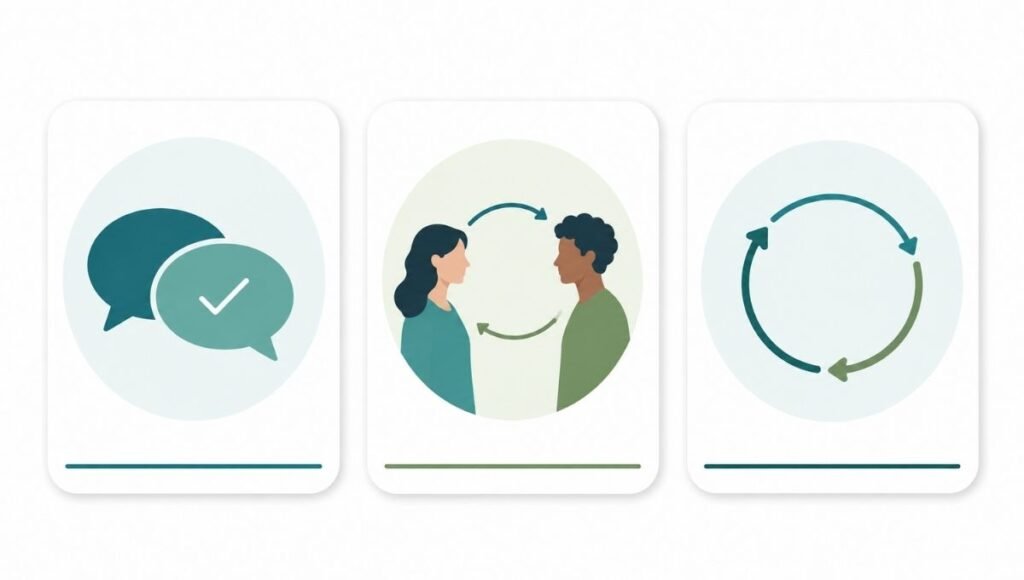
The clearest, most unambiguous form of consent. Direct words — “yes,” “I’d like that,” “I want to” — remove the interpretive layer that non-verbal communication always involves. Verbal consent is particularly important at the beginning of new sexual encounters, when transitioning between different types of activity, when the situation is new or unfamiliar, and any time there is uncertainty about how a partner is feeling.
A common concern: won’t asking ruin the moment? The honest answer is no — not if it is done naturally and without performative awkwardness. “Is this okay?” asked with genuine warmth and attention is not a clinical interruption. For most people, being genuinely asked whether something feels good is itself an intimate and reassuring experience.
Non-Verbal Consent
Non-verbal consent — communicated through body language, physical responsiveness, and active participation — is real and meaningful in established relationships where partners know each other well. It includes things like moving toward a partner, reciprocating touch, and engaged physical participation.
Non-verbal consent has limits, however. Body language can be misread, particularly under conditions of discomfort, anxiety, or ambivalence. Silence or stillness is not non-verbal consent — it is the absence of a signal, which is different. When in doubt about what non-verbal communication is expressing, verbal check-in is always appropriate.
Ongoing Consent
Perhaps the most underappreciated type: consent is not a one-time transaction. It applies throughout an encounter and across time. Agreeing to one thing is not agreement to everything. Something that was welcome on a previous occasion is not automatically welcome now. Consent given at the beginning of an encounter can be withdrawn at any point, for any reason, without requiring an explanation.
In long-term relationships, the habit of ongoing consent — checking in, staying attentive to a partner’s engagement, noticing when enthusiasm has shifted — is one of the practices most consistently associated with sustained sexual satisfaction and relational security.
What Is Affirmative Consent: The Active Standard
Affirmative consent is the principle that agreement to sexual activity should be actively expressed rather than assumed from the absence of objection. Rather than “did they say no?”, affirmative consent asks “did they say yes — clearly and freely?”
This standard has been adopted in law in a growing number of jurisdictions, particularly in institutional settings such as universities. California’s “yes means yes” law, enacted in 2014, was among the first legislative expressions of affirmative consent as a legal standard and has been influential in policy development elsewhere.
The practical difference between affirmative and non-affirmative consent:
Non-affirmative: Going ahead with something because a partner did not object.
Affirmative: Going ahead with something because a partner actively expressed agreement.
The gap between these two positions is exactly where most unwanted sexual experiences occur — not in the extreme cases, but in the ordinary moments where one person assumed agreement from the absence of objection, and the other felt unable or unwilling to voice their discomfort.
The editor’s honest view: affirmative consent is not complicated. It is checking in, reading engagement, asking when uncertain, and treating a partner’s genuine willingness as something worth knowing rather than something to assume. Most people do this already in contexts where it feels natural — the skill is extending it consistently, particularly in moments where uncertainty would be easy to overlook.
Consent in Relationships: Long-Term Partners and the Risk of Assumption
Consent in relationships is an area where the gap between what people know and what they practice tends to be largest. In long-term partnerships, many couples gradually shift from active consent to a system of assumption — where the default is “yes unless otherwise indicated,” often without either partner consciously choosing this arrangement.
For some couples, this implicit arrangement works. But research suggests it works less universally than people assume. A 2019 study published in the Archives of Sexual Behavior found that a significant proportion of partnered adults reported sexual experiences within their relationships that they experienced as unwanted — not because of overt pressure, but because consent had never been explicitly revisited as circumstances and desires changed over time.
Relationship tenure does not reduce the need for consent — it changes its form. In long-term relationships, consent becomes less about dramatic first-time checks and more about an ongoing relational environment: partners who regularly communicate about desire and preferences, who notice and respond to shifts in engagement, who treat each other’s ongoing willingness as something worth tending rather than something to assume.
Practical applications for established couples:
Talk about preferences outside of sexual encounters. Having conversations about what each person enjoys, values, and is currently interested in — at a neutral time, not in the heat of the moment — creates shared understanding that makes in-the-moment communication both easier and less loaded.
Check in when you notice reduced engagement. “You seem a bit somewhere else tonight — do you want to continue, or would you rather just be together?” This kind of attentive check-in, offered without pressure or disappointment in the response, communicates that a partner’s genuine engagement matters.
Revisit arrangements that were established a long time ago. Desire, preferences, and comfort levels change. An explicit or implicit arrangement that worked well three years ago may not accurately reflect where both people are now. Creating space to revisit these conversations is an act of relational care.
How to Ask for Consent: Practical Language That Actually Works
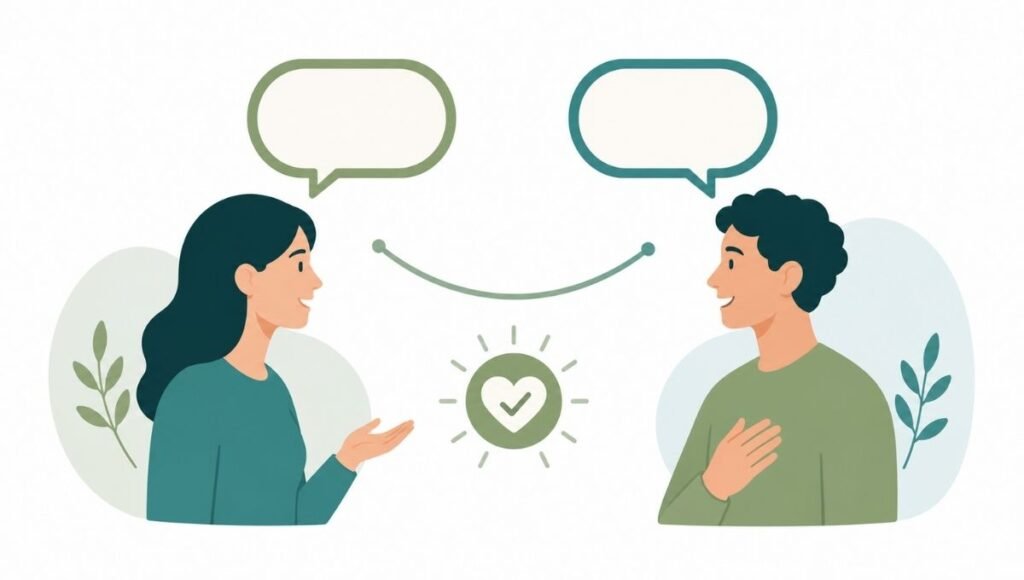
For many people, the difficulty is not understanding consent intellectually — it is finding language that feels natural rather than clinical or performative. Some approaches that work:
Direct and warm: “Is this okay?” “Do you want this?” “I really want to — do you?” These are simple, genuine, and do not require elaborate framing.
Descriptive and inviting: “I’d like to [specific thing] — is that something you’re into?” This is slightly more specific and gives a partner a concrete thing to respond to rather than a general check-in.
Checking in during: “Is this still good?” “Do you want to keep going?” “How does this feel?” These work particularly well for signalling attentiveness during an encounter rather than treating consent as a one-time gate at the beginning.
Responding to uncertainty: “I noticed you went quiet — are you comfortable?” “You can always say if you want to stop or change anything.” These create explicit permission to withdraw consent without having to initiate that conversation from scratch.
If you only have 10 minutes right now: Practice saying one of these phrases out loud, to yourself, until it stops feeling awkward. The discomfort of asking for consent is almost always a familiarity issue — it fades with practice. The discomfort of not asking, or of proceeding without genuine agreement, is considerably more significant and lasting.
Consent vs Coercion: Recognising the Difference
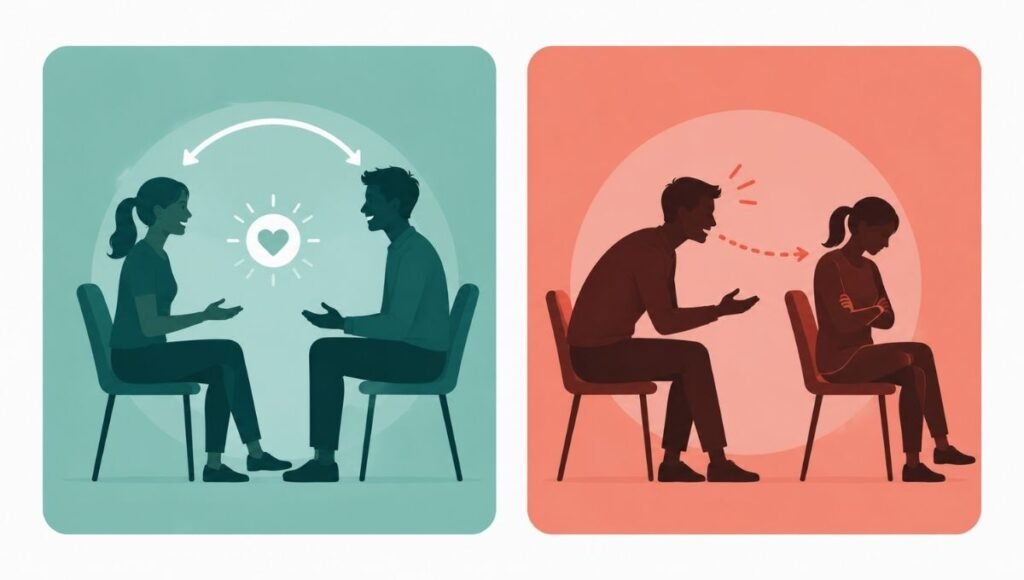
Consent and coercion are opposites — but the line between them is not always as clear in practice as it is in principle. Coercion includes not only explicit threats or force but also more subtle forms of pressure:
- Persistent asking after a partner has said no or expressed hesitation
- Making a partner feel guilty, selfish, or inadequate for declining
- Using emotional leverage (“if you loved me, you would”)
- Creating situations in which declining feels unsafe or costly
- Proceeding with something a partner has agreed to under pressure, when their “yes” was clearly not genuine
The presence of a “yes” does not automatically indicate the presence of consent, if that “yes” was produced through pressure, manipulation, or a context in which declining felt impossible. Genuine consent requires that refusal be genuinely available — that a “no” would be received respectfully and without negative consequences.
This is why the environment in which consent is sought matters as much as the specific response. Partners who consistently respond to “no” with warmth and respect create the conditions in which genuine “yes” is possible. Partners who respond to “no” with disappointment, withdrawal, or pressure gradually erode the conditions for authentic agreement.
Warning Signs: When to Seek Support
If you have experienced sexual activity that did not feel consensual — within a relationship or outside of one — you are not alone, and support is available. RAINN’s National Sexual Assault Hotline (1-800-656-HOPE) provides confidential support 24/7. Online chat is available at rainn.org.
If you are in a relationship where expressing your preferences or declining sexual activity consistently produces negative responses — anger, guilt, emotional withdrawal — this is worth taking seriously as a pattern that may benefit from professional support, either individual or couples therapy.
If you are uncertain whether your own approach to consent in a relationship is serving both you and your partner well, a conversation with a therapist who specialises in sexual health or relationship dynamics can provide clarity and practical guidance.
Frequently Asked Questions
What is enthusiastic consent? Enthusiastic consent means that agreement to sexual activity is not just technically present but actively and genuinely expressed — both partners actually want what is happening, rather than one or both simply going along with it. It is the difference between a reluctant “okay” and a genuine “yes.” Enthusiastic consent is the standard that reflects real respect for both people involved, not just the legal minimum.
Does consent need to be verbal? Not always — non-verbal consent is real and meaningful in relationships where partners know each other well. But verbal consent is clearer, less subject to misinterpretation, and particularly important in new encounters, when transitioning between activities, or whenever there is any uncertainty about how a partner is feeling. When in doubt, ask directly.
Does consent in a long-term relationship work differently? The form changes, but the principle does not. Long-term partners often develop implicit systems of communication about consent, which can work well when both people are genuinely engaged and comfortable expressing boundaries. The risk is that assumption gradually replaces active communication — and that over time, one partner’s genuine engagement is no longer being checked for. Regularly communicating about preferences and checking in during intimate encounters remains meaningful regardless of relationship length.
What is affirmative consent? Affirmative consent is the principle that agreement to sexual activity should be actively expressed rather than assumed from the absence of objection. It asks not “did they say no?” but “did they clearly and freely say yes?” It is both an ethical standard and a legal standard in a growing number of jurisdictions.
Can consent be withdrawn after it has been given? Yes — at any point, for any reason, without explanation required. Agreeing to something at the beginning of an encounter does not commit a person to that agreement for the duration. If a partner withdraws consent — verbally or through clear non-verbal signals — the appropriate response is to stop immediately, check in with care, and accept the withdrawal without pressure or disappointment expressed toward the partner.
How do I ask for consent without it feeling awkward? The awkwardness almost always reflects unfamiliarity rather than anything inherent to the question itself. Asking “is this okay?” with genuine warmth is not a clinical interruption — for most people, being genuinely checked in on is itself a positive experience. Practice helps. Framing it as part of ordinary communication rather than a formal threshold to clear also reduces the sense of formality.
The Bottom Line
Enthusiastic consent is not a compliance exercise — it is a relational practice that directly shapes how safe, respected, and genuinely connected both partners feel in intimate life.
The shift from “did they say no?” to “are they genuinely here with me?” is not a subtle one. It changes the quality of intimate experience, the degree of trust between partners, and the foundation on which a shared sexual life is built.
Consent, practised consistently, is one of the most straightforward ways to make intimacy better for everyone involved — not because it prevents bad things, but because it creates the conditions for good ones.
References
- RAINN. Consent 101: Respect, Boundaries, and Building Trust. Updated 2025. https://rainn.org/share-the-facts/consent-101-respect-boundaries-and-building-trust/
- Beres MA. ‘Spontaneous’ sexual consent: An analysis of sexual consent literature. Feminism & Psychology. 2007;17(1):93–108.
- Humphreys TP. Cognitive frameworks of virginity and first intercourse. Journal of Sex Research. 2013;50(1):19–30.
- Muehlenhard CL, et al. Evaluating the One-in-Five Statistic: Women’s Risk of Sexual Assault While in College. Journal of Sex Research. 2017;54(4-5):549–576.
- California Legislative Information. SB-967 Student safety: sexual assault. 2014. https://leginfo.legislature.ca.gov