

Most of what we know about relationships, we learned by watching other people’s. The relationships we grew up around became our templates — for what intimacy looks like, how conflict is handled, what love is supposed to feel like, what is normal to tolerate and what is not. For many of us, those templates were imperfect at best.
The gap between what we absorbed and what we actually want from our intimate lives is where most relationship difficulty lives. Not in dramatic failure or obvious dysfunction, but in the quiet distance between two people who care about each other and still cannot quite seem to get close — or who get close and cannot seem to stay there.
Relationship health is not a fixed state you achieve and then maintain automatically. It is a practice: a set of skills, habits, and orientations toward yourself and your partner that require ongoing attention, honest assessment, and the willingness to keep learning. This guide provides the framework — covering what healthy relationships actually look like, the specific skills that support intimacy and connection, and the evidence-based resources available when you need them.
Key Takeaways
- Relationship quality is one of the strongest independent predictors of physical and mental health outcomes across all adult age groups, according to a 2023 meta-analysis published in PLOS Medicine analysing data from over 220,000 adults.
- Healthy relationships are not conflict-free — they are characterised by the ability to repair after conflict, communicate honestly, and maintain genuine respect for each other’s individuality and autonomy.
- The skills that support relationship health — communication, emotional regulation, boundary-setting, consent, and understanding how each person gives and receives love — are learnable. They are not fixed personality traits that either you have or you do not.
- Sexual health and relationship health are directly interconnected. Couples who communicate openly about sexual health concerns, preferences, and needs report significantly higher satisfaction in both domains than those who avoid these conversations.
- The most consistent predictor of long-term relationship satisfaction in research is not compatibility, shared interests, or the intensity of early attraction — it is the quality of communication between partners, particularly during and after disagreement.
What Relationship Health Actually Means

Relationship health is not the absence of difficulty. Every relationship encounters conflict, misunderstanding, periods of distance, and the accumulating complexity of two people’s needs, histories, and limitations in ongoing contact with each other.
What distinguishes healthy relationships from unhealthy ones is not the presence or absence of these experiences. It is the presence of the resources — communication capacity, mutual respect, emotional safety, and shared commitment — needed to navigate them without causing lasting damage.
Relationship researchers have identified several dimensions that consistently predict long-term relational health and satisfaction. These include:
Emotional safety — the experience that you can be honest about what you think, feel, and need without anticipating contempt, dismissal, or punishment in response. This is the foundation on which everything else depends. Without it, communication is performance, intimacy is surface-level, and conflict is dangerous rather than navigable.
Mutual respect for autonomy — healthy relationships hold two people who remain distinct individuals. Each partner maintains friendships, interests, and a sense of identity outside the relationship. Neither person is expected to abandon who they are as evidence of commitment.
Repair capacity — the ability to return to connection after disconnection. Every couple experiences ruptures — moments of hurt, misunderstanding, and conflict. What predicts long-term relationship health is not the frequency of ruptures but the consistency of repair. Couples who repair quickly and genuinely tend to maintain relational health even through significant difficulty.
Honest communication — the capacity to raise concerns, express needs, set limits, and discuss sensitive topics — including sexual health — without the conversation becoming a crisis. This is perhaps the most learnable dimension of relationship health, and the one most amenable to deliberate development.
Relationship Communication Skills: The Foundation of Everything Else
Communication is where relationship health is most directly built or eroded — and it is the area where most couples have the most room for meaningful improvement.
Effective relationship communication is not about saying everything that comes to mind, or about never having difficult conversations. It is about developing the capacity to raise what matters — needs, concerns, preferences, limits — in ways that give your partner the opportunity to actually hear you.
The research on communication in relationships is extensive and consistent on several points:
How you raise a concern matters as much as what the concern is. Conversations that begin with criticism of character — “you never,” “you always,” “you’re so” — consistently produce defensiveness rather than understanding. The same concern raised with first-person language and specific framing — “I feel unheard when,” “I need more of” — produces significantly different responses.
Listening to understand is a distinct skill from listening to respond. Most people in conflict are listening for the pause in which they can make their own point. Genuine listening — staying with what your partner is saying long enough to actually understand their position before formulating yours — is rarer and more impactful than it sounds.
Timing matters enormously. Difficult conversations almost always go better when initiated at a calm, neutral moment — not in the middle of an argument, not immediately after the triggering incident, and not when either person is exhausted, hungry, or emotionally flooded.
Repair matters more than resolution. Not every disagreement reaches resolution, and not every difference needs to be reconciled. What healthy couples do consistently is repair — acknowledge their contribution to the rupture, return to connection, and not allow damage to accumulate in silence.
→ For a complete, practical guide to relationship communication: How to Communicate in a Relationship
Signs of a Healthy Relationship: What to Look For
Many people find it easier to recognise what is wrong in a relationship than what is right. The research on relationship health offers a more specific vocabulary — one that makes it possible to assess not just what is missing but what is genuinely present.
The most consistently identified signs of a healthy relationship include:
You feel safe expressing yourself honestly. Not just about small things — about disagreement, discomfort, need, and vulnerability. And the response, even to difficult things, does not make you feel smaller or less secure than before you spoke.
Conflict moves toward repair rather than accumulation. Arguments end — not always in agreement, but in reconnection. Resentments do not quietly accumulate. Apologies are genuine and followed by behavioural change.
Both partners maintain individual identity. Each person has friendships, interests, and pursuits outside the relationship that the other actively supports rather than experiences as threatening.
Difficult topics can be raised. Including sexual health concerns, changes in desire, financial stress, and anything else that actually affects your shared life. A relationship in which certain topics are permanently off limits is one in which both people are performing a partial version of themselves.
You feel known — specifically, and currently. Not known based on a version of you from three years ago, but known in the present: your current worries, current joys, current struggles.
Relationship red flags — signs that a relationship may be unhealthy — include the consistent presence of contempt, persistent dismissal of one partner’s expressed needs, isolation from outside relationships and support, control of finances or movement, and any experience of fear in relation to a partner’s response.
→ For a complete guide to what healthy relationships look like in practice: Signs of a Healthy Relationship: Traits, Habits and How to Build One
Relationship Anxiety: When Fear Disrupts Connection
Relationship anxiety — the persistent experience of worry, doubt, and insecurity within a romantic relationship, even when the relationship is functioning well — is one of the most common and least discussed sources of relational difficulty.
It manifests differently in different people: constant reassurance-seeking, interpreting neutral partner behaviour as threatening, replaying conversations looking for problems, fear of abandonment that feels perpetually urgent. The defining characteristic is that the anxiety is internally generated — driven by patterns of thought and attachment history rather than by the partner’s actual behaviour.
This distinction matters. Concern about a relationship in which there are genuine problems — dishonesty, inconsistency, disrespect — is appropriate responsiveness to real information. Relationship anxiety produces fear and doubt in circumstances that do not warrant them. The relationship is good. The partner is present and invested. And the anxious mind still finds a way to be afraid.
Understanding the roots of relationship anxiety — most commonly in anxious attachment patterns developed in early relationships — shifts the work from “fixing” the anxiety to understanding where it comes from and building a different relationship with it. This is work that responds well to therapy, to self-directed practice, and to the experience of a consistently secure relationship over time.
→ For a complete guide to recognising and addressing relationship anxiety: Relationship Anxiety: Symptoms, Causes and How to Address It
Emotional Intimacy: The Core of Lasting Connection
Emotional intimacy is the experience of being genuinely known by a partner — not just logistically co-ordinated with them. It involves the capacity to share your inner world honestly, and to have that sharing received without judgment or dismissal.
It is built through accumulation — through small moments of honesty that are received well, through repeated experiences of bringing something real and finding it safe to do so. And it erodes through the opposite: through the habit of managing feelings privately rather than sharing them, through conversations that stay on the logistics of life and never go beneath the surface.
Research consistently identifies emotional intimacy as one of the strongest predictors of relationship satisfaction and sexual satisfaction — more strongly associated with both than the frequency of sexual activity. This is one of the clearest illustrations of how relationship health and sexual health are not separate domains but deeply interconnected ones.
The most evidence-supported practices for building emotional intimacy are surprisingly accessible: genuine curiosity about your partner’s inner experience, attentive listening, consistently “turning toward” their bids for connection rather than missing them, and the practice of graduated vulnerability — sharing something real, and discovering it is received well enough to share something more real next time.
→ For a complete guide to building and restoring emotional intimacy: Emotional Intimacy: What It Is and How to Build It
Consent in Relationships: An Ongoing Practice, Not a One-Time Gate
Consent is frequently framed as a threshold — something to establish once at the beginning of sexual activity. In healthy relationships, it functions differently: as an ongoing practice of mutual attention, honest communication, and genuine responsiveness to each other’s engagement and comfort.
Enthusiastic consent — a mutual, freely given, and actively expressed agreement to sexual activity — is the standard that reflects genuine respect for both partners. It is not the legal minimum of the absence of “no.” It is the active, willing presence of a “yes” — both partners genuinely interested and engaged in what is happening.
In long-term relationships, the practice of consent evolves. It becomes less about explicit verbal confirmation at every moment and more about an ongoing relational environment: partners who regularly communicate about desire and preferences, who notice and respond to shifts in engagement, and who treat each other’s genuine willingness as something worth tending rather than something to assume.
This matters for sexual health in a direct and practical way. Couples who communicate openly about consent — including about changes in desire, physical comfort, and sexual preferences — report significantly higher sexual satisfaction and overall relational well-being than those who rely on assumption or avoid these conversations.
→ For a complete guide to consent in relationships: Sexual Consent: What It Means, How to Ask, and Why It Matters
Setting Boundaries in Relationships: Honesty About What You Need
Boundaries in relationships are not walls. They are the honest communication of your needs, your limits, and what affects your sense of safety and well-being — information that allows your partner to actually know you rather than a curated, accommodating version of you.
The most important types of boundaries in intimate relationships include emotional boundaries (protecting your inner life and sense of self), physical and sexual boundaries (governing comfort with touch and intimacy), time and energy boundaries (governing how you allocate your finite resources), and digital boundaries (governing privacy and how the relationship is represented publicly).
Healthy boundaries share several characteristics: they are expressed in first-person terms, they are specific rather than vague, and they are accompanied by a request rather than issued as a non-negotiable demand. “I need some time to decompress after work before we discuss anything significant” is a boundary. “You are not allowed to talk to me when I get home” is not — one expresses a need, the other attempts to control behaviour.
The most consistent finding in research on boundaries and relationship satisfaction is straightforward: people who can identify and communicate their needs in relationships report higher satisfaction, lower conflict intensity, and greater individual well-being. The ability to say what you need — and to receive what your partner needs in return — is not a sign of difficulty. It is a sign of relational health.
→ For a complete guide to setting and communicating healthy boundaries: Setting Boundaries in Relationships: Types, Examples and How to Communicate Them
Love Languages: Understanding How Your Partner Gives and Receives Love
One of the most practically useful frameworks for understanding relational disconnection is Gary Chapman’s concept of love languages — the observation that people tend to express love through the means that feel most meaningful to them, and to expect love to be expressed back in those same terms.
The five love languages — acts of service, words of affirmation, quality time, physical touch, and receiving gifts — are not personality types. They are tendencies: the forms of love expression that register most clearly for a given person as evidence that they are loved, valued, and seen.
The most common relational difficulty the framework illuminates is not that one partner does not love the other — it is that they have been loving each other in different dialects and both have been missing it. The partner who handles logistics, maintains the home, and takes care of practical needs may be expressing profound love through acts of service — and their partner, who most registers love through verbal affirmation, may be feeling unloved despite the constant practical care surrounding them.
Understanding your own primary love language and your partner’s — and making deliberate effort to express love in the language your partner actually receives — is one of the most accessible and impactful practices available for improving day-to-day relational experience.
→ For a complete guide to all five love languages with examples and practical application: The 5 Love Languages Explained: What They Mean and How to Use Them
Relationship Health and Sexual Well-Being: The Connection
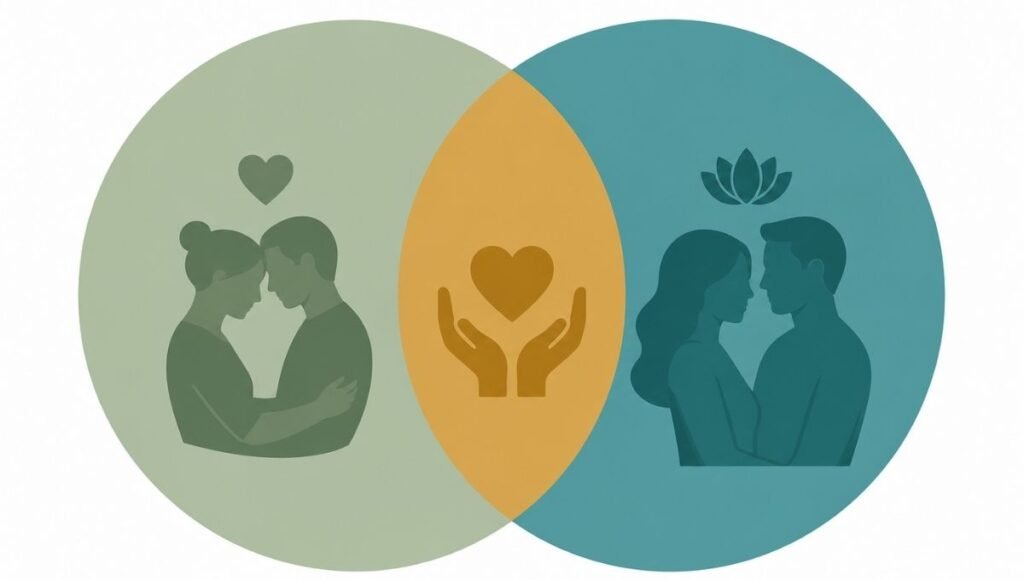
Relationship health and sexual health are not separate domains — they are deeply interconnected, and changes in one consistently affect the other.
Research is consistent on several key connections:
Emotional intimacy predicts sexual satisfaction more strongly than sexual frequency. Couples who feel genuinely known, seen, and safe with each other report greater sexual satisfaction than those who engage in sexual activity more frequently but within a less emotionally connected relationship.
Communication about sexual health improves both relational and sexual outcomes. Couples who talk openly about desire, preferences, physical comfort, STI status, and contraception report higher satisfaction in both the sexual and relational dimensions of their partnership. These conversations, which many couples find difficult to initiate, consistently produce positive effects when they happen.
Relationship anxiety directly affects sexual well-being. Anticipatory anxiety, fear of vulnerability, and the emotional distance that relationship anxiety can create all suppress sexual desire and comfort. Addressing the relational anxiety often improves the sexual dimension of the relationship — more so than addressing the sexual dimension directly.
Changes in sexual desire or comfort are normal and worth communicating about. Desire fluctuates across life stages, hormonal changes, stress levels, relationship phases, and individual circumstances. Partners who can raise these changes honestly — rather than accommodating them silently or attributing them to something being wrong — navigate them significantly more effectively.
Building Trust in Relationships: How It Works and How It Repairs
Trust in relationships is not primarily about fidelity, though it includes it. It is about reliability — the consistent experience that your partner does what they say, shows up when they say they will, and can be counted on in the ways that matter to you.
Trust is built through small, consistent actions over time rather than grand gestures. It erodes through small, consistent inconsistencies — promises not kept, needs routinely deprioritised, patterns that contradict stated values. These erosions are often individually minor. Accumulated over months or years, they produce a relational environment in which genuine vulnerability feels too risky.
Rebuilding trust after significant breach — whether infidelity, repeated dishonesty, or a pattern of broken commitments — is possible but requires something specific: sustained behavioural change over time, not reassurance alone. The body registers patterns, not promises. It updates not because someone says they have changed but because they consistently demonstrate it across enough time and enough situations that the nervous system genuinely has new evidence to work with.
Professional support — individual therapy, couples therapy, or both — is often the most effective context for this work, particularly when patterns are entrenched or when both partners need a structured environment in which to be heard and to understand what actually happened.
Relationship Red Flags: When to Pay Attention
Relationship red flags are patterns — not isolated incidents — that warrant serious attention rather than accommodation or explanation away.
The most clinically significant red flags include:
- Consistent contempt — dismissiveness, mockery, or cruelty in response to a partner’s expression of need or vulnerability
- Isolation from outside relationships and support — whether through direct pressure or through patterns that make maintaining those connections feel too difficult
- Control of finances, movement, or information
- Persistent dismissal of one partner’s clearly expressed needs, feelings, or limits
- Any experience of fear in relation to a partner’s emotional response
- A pattern in which conflict escalates to hostility rather than moving toward repair
These are not communication problems that better phrasing will solve. They are patterns that indicate a relationship dynamic in which genuine safety — the foundation of everything else — may not be reliably present.
When to Seek Professional Support
The following signal that professional support — individual therapy, couples therapy, or both — is appropriate rather than continued self-directed effort:
- Recurring conflicts that self-directed effort has not resolved over time
- Significant emotional distance or loneliness within the relationship that has persisted despite genuine effort to address it
- Either partner experiencing depression, anxiety, or emotional withdrawal that is affecting relational engagement
- A pattern of boundary violations that has continued despite clear communication
- Any concern about emotional or physical safety
- A significant breach of trust that has not been adequately addressed
- Communication that consistently escalates rather than moves toward repair
Couples therapy — particularly Emotionally Focused Therapy (EFT) or the Gottman Method — has a strong evidence base for improving relational outcomes across a wide range of presenting concerns, including in relationships where difficulty has been longstanding. Earlier intervention consistently produces better outcomes than seeking help only when a relationship is in acute crisis.
Explore All Relationship and Intimacy Health Topics on PureInti

The following guides cover each dimension of relationship and intimacy health in complete, evidence-based detail:
Communication and Connection
- How to Communicate in a Relationship: A Practical Guide to Talking Openly and Building Trust
- Emotional Intimacy: What It Is, Why It Matters, and How to Build It in Your Relationship
- The 5 Love Languages Explained: What They Mean and How to Use Them in Your Relationship
Relationship Health and Patterns
- Signs of a Healthy Relationship: Traits, Habits, and How to Build One That Lasts
- Relationship Anxiety: Symptoms, Causes, and Evidence-Based Ways to Address It
- Setting Boundaries in Relationships: Types, Examples, and How to Communicate Them Clearly
Consent and Safety
References
- Holt-Lunstad J, et al. Social relationships and mortality risk: a meta-analytic review. PLOS Medicine. 2010;7(7):e1000316.
- Montesi JL, et al. The specific importance of communicating about sex to couples’ sexual and overall relationship satisfaction. Journal of Social and Personal Relationships. 2013;30(7):959–976.
- Gottman JM, Silver N. The Seven Principles for Making Marriage Work. Harmony Books; 2015.
- Johnson SM. Hold Me Tight: Seven Conversations for a Lifetime of Love. Little, Brown Spark; 2008.
- Lavner JA, Karney BR, Bradbury TN. Does couples’ communication predict marital satisfaction, or does marital satisfaction predict communication? Journal of Marriage and Family. 2016;78(3):680–694.