

Here is something that does not get said often enough: the vagina is remarkably good at taking care of itself. It has an entire self-regulating ecosystem — a carefully maintained chemical environment, a community of protective bacteria, a continuous natural cleaning process — that, under normal circumstances, operates without any intervention.
And yet most of us grew up with the impression that vaginal health required active management: special washes, douches, scented products, particular diets, specific routines. The wellness industry has built considerable commercial territory on this impression. Much of it is not just unnecessary — some of it actively disrupts the very system it claims to support.
The most useful thing most women can do for their vaginal health is understand how it actually works. What the normal pH range is and why it matters. What healthy discharge looks and feels like, and what changes are worth attention. What genuinely supports vaginal health and what does not. And when something warrants a clinical evaluation rather than a product.
That is what this guide covers.
Key Takeaways
- Healthy vaginal pH falls between 3.8 and 4.5 in women of reproductive age — an acidic environment maintained primarily by Lactobacillus bacteria and essential for protecting against infection.
- Normal vaginal discharge varies significantly between individuals and across the menstrual cycle. Colour, consistency, and volume all change naturally — this is normal physiology, not a problem to solve.
- The vagina is self-cleaning. Douching, internal washing, and scented products disrupt the vaginal microbiome and pH balance — they do not improve vaginal health and can cause the problems they claim to prevent.
- Bacterial vaginosis (BV) — the most common vaginal condition — is caused by a shift in the bacterial balance of the vaginal microbiome, not by poor hygiene. It is treatable with antibiotics and does not reflect on personal cleanliness.
- Several common factors disrupt vaginal pH balance: menstruation (blood is alkaline), unprotected sexual activity, antibiotics, hormonal changes, and certain hygiene products. Understanding these helps make more informed choices.
What Is Vaginal pH Balance and Why Does It Matter
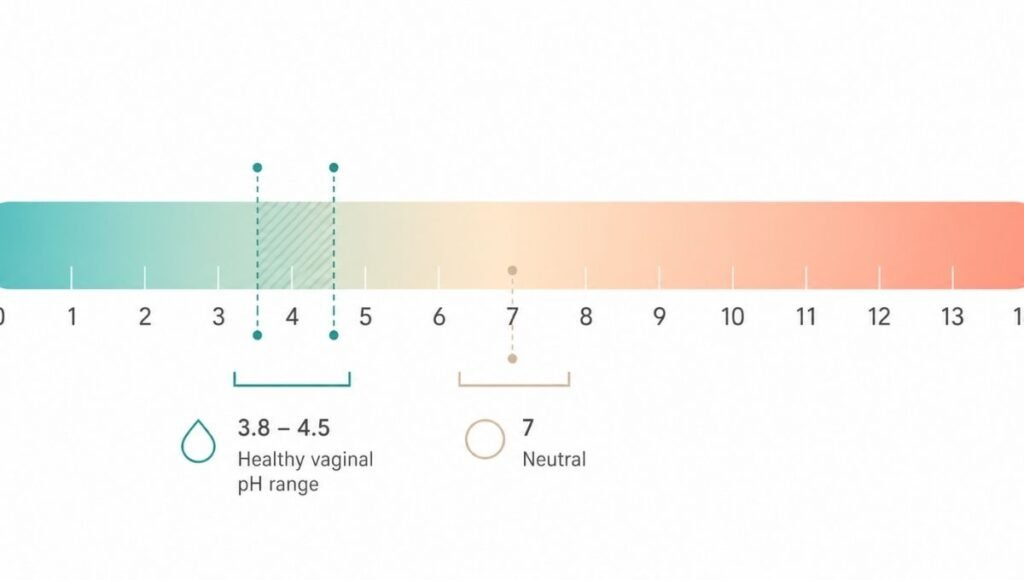
pH is a measure of acidity or alkalinity on a scale of 0 to 14, where 7 is neutral, values below 7 are acidic, and values above 7 are alkaline. The vaginal environment in women of reproductive age is typically acidic, with a pH between 3.8 and 4.5 — roughly similar to wine or tomato juice.
This acidity is not incidental. It is actively maintained, primarily by Lactobacillus bacteria — the dominant bacterial species in a healthy vaginal microbiome — which produce lactic acid as a metabolic byproduct. That lactic acid creates the acidic environment that inhibits the growth of most pathogenic bacteria and fungi. The pH is, in effect, the vaginal immune system’s first line of defence.
When vaginal pH rises — becoming less acidic, more alkaline — this protective barrier weakens. Pathogenic bacteria that cannot survive in an acidic environment find conditions more favourable. The risk of bacterial vaginosis, yeast infections, and sexually transmitted infections increases. This is why vaginal pH balance is clinically significant: it is not an abstract metric but a functional health indicator.
Normal vaginal pH varies across life stages. In premenopausal women, the range of 3.8–4.5 is typical. During menopause, declining oestrogen reduces Lactobacillus populations and lactic acid production, allowing pH to rise — typically to between 5 and 7. This shift in pH is one of the mechanisms underlying increased vaginal dryness and infection susceptibility in the postmenopausal period.
The Vaginal Microbiome: What It Is and Why It Matters
The vaginal microbiome is the community of microorganisms — primarily bacteria — that inhabit the vaginal environment. In women of reproductive age with good vaginal health, this community is typically dominated by one or more species of Lactobacillus: most commonly L. crispatus, L. iners, L. jensenii, or L. gasseri.
These bacteria are not passive residents. They actively shape the vaginal environment through lactic acid production, through the production of hydrogen peroxide (which has antimicrobial properties), and through competition with potentially harmful microorganisms for space and resources. A Lactobacillus-dominant vaginal microbiome is associated with lower rates of bacterial vaginosis, yeast infections, and STI acquisition.
A less Lactobacillus-dominant microbiome — more diverse but with lower proportions of protective bacteria — is associated with higher susceptibility to infection and is more common in certain populations. Research has established that vaginal microbiome composition is influenced by genetics, ethnicity, hormonal status, sexual behaviour, and the products used in or near the vagina.
The practical implication: the vaginal microbiome is a living ecosystem that is supported or disrupted by the environment it lives in. Factors that maintain appropriate pH — avoiding products that alter it, being thoughtful about antibiotics, supporting Lactobacillus populations through dietary and lifestyle choices — support the microbiome. Factors that disrupt pH disrupt the microbiome.
What Does Healthy Vaginal Discharge Look Like
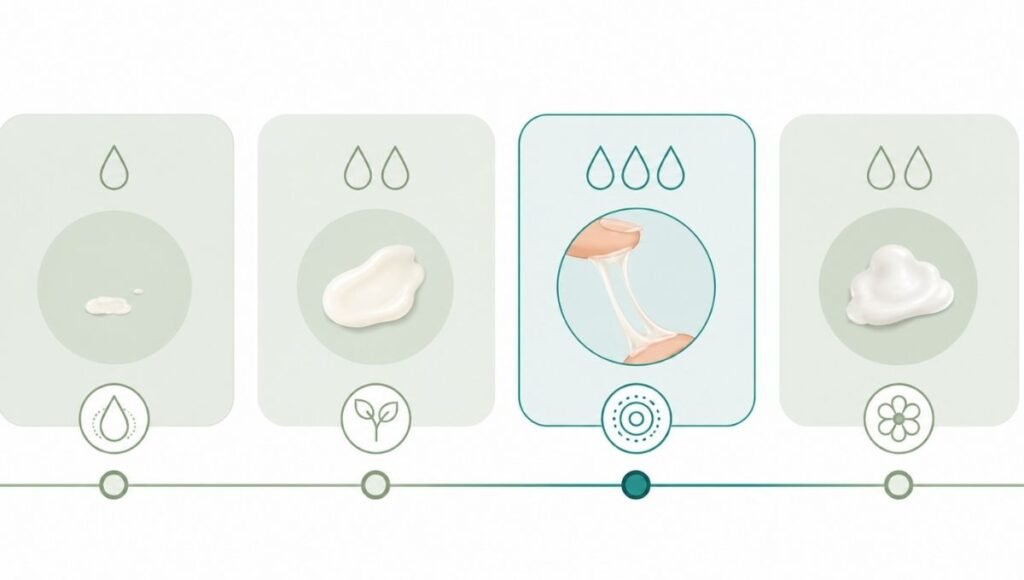
Vaginal discharge is one of the most frequently googled vaginal health questions — and one of the most frequently misunderstood. The short version: normal discharge varies enormously, and most of what women worry about is within the range of normal physiology.
Normal vaginal discharge is produced by the cervix and vaginal walls as part of the continuous self-cleaning process. It changes throughout the menstrual cycle in response to hormonal shifts:
Immediately after menstruation: Discharge is typically minimal, sometimes absent.
In the follicular phase (days 6–14 roughly): Discharge increases as oestrogen rises. It is typically white or clear, with a consistency ranging from creamy to slightly stretchy.
Around ovulation: Discharge increases significantly and becomes clearer, more slippery, and stretchy — often described as resembling raw egg white. This is fertile cervical mucus, produced specifically to facilitate sperm transport. It is entirely normal and indicates healthy hormonal function.
After ovulation (luteal phase): Discharge typically decreases and becomes thicker, creamier, or stickier under the influence of progesterone.
Normal discharge is odourless or has a mild, slightly acidic scent. It may be white, off-white, clear, or slightly yellowish when dry on underwear. Volume varies between individuals — some women produce noticeably more than others, and both are normal.
Signs that discharge warrants clinical evaluation:
- A strong, fishy, or noticeably unpleasant odour — particularly after sexual activity (characteristic of bacterial vaginosis)
- Thick, white, cottage-cheese-like discharge with itching (characteristic of yeast infection)
- Yellow, green, or grey discharge, particularly with an unusual odour
- Discharge accompanied by significant itching, burning, or pelvic pain
- Any change in discharge that does not correspond to the normal cycle pattern
Vaginal Odor Causes: What Is Normal and What Is Not
Vaginal odour is another topic surrounded by significant misinformation — primarily driven by hygiene product marketing that has convinced many women that any vaginal scent is a problem requiring intervention. It is not.
A mild, slightly musky or acidic scent is entirely normal and reflects the acidic pH and bacterial composition of a healthy vaginal environment. This scent varies between individuals, across the menstrual cycle, and in response to factors including diet, hydration, and physical activity. It is not a hygiene failure. It is normal physiology.
Odours that may indicate a clinical concern:
A strong fishy odour — particularly one that intensifies after sexual activity or during menstruation — is the characteristic sign of bacterial vaginosis (BV). BV occurs when the balance of bacteria in the vaginal microbiome shifts, with a reduction in Lactobacillus and an overgrowth of other bacterial species. It is the most common vaginal condition in women of reproductive age, affecting an estimated 21 million women in the United States annually, according to the CDC. It is not caused by poor hygiene and does not reflect on personal cleanliness. It is treated with antibiotics — metronidazole or clindamycin — and resolves reliably with appropriate treatment.
A yeasty or bread-like odour alongside thick, white discharge and significant itching suggests a yeast infection (vaginal candidiasis), caused by overgrowth of Candida species. Yeast infections are treated with antifungal medication — available over-the-counter in many countries or by prescription.
The editor’s honest view: douching or using scented products to address vaginal odour makes the situation worse, not better. Introducing alkaline products into the vaginal environment disrupts pH, reduces Lactobacillus populations, and increases susceptibility to the very infections that produce the odours you are trying to eliminate. If you have a persistent odour that concerns you, a clinical evaluation is the appropriate response — not a hygiene product.
What Disrupts Vaginal pH Balance
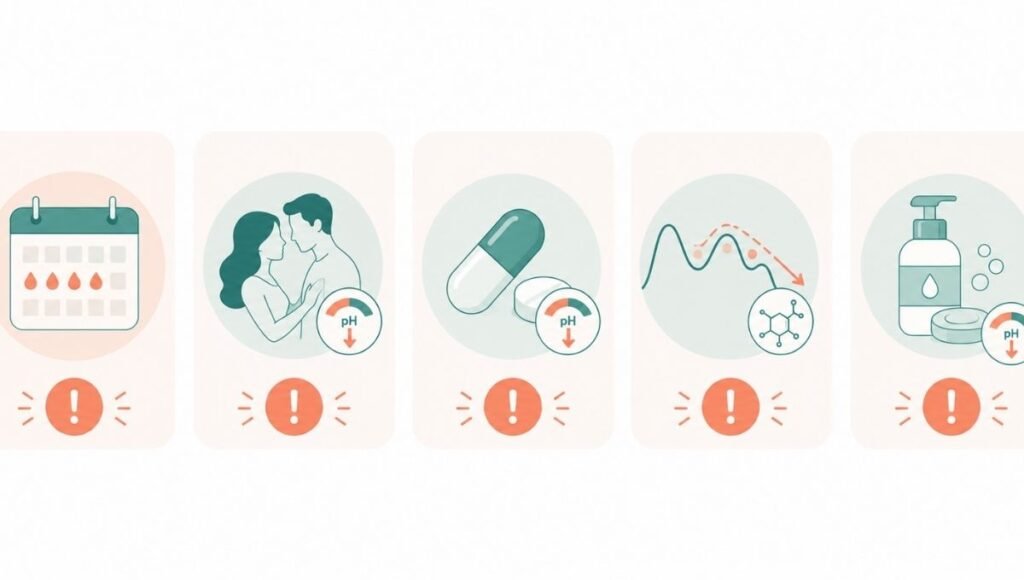
Several common factors raise vaginal pH — making it less acidic and reducing the protective function of the vaginal environment:
Menstruation — Blood has a pH of approximately 7.4 — significantly more alkaline than the healthy vaginal environment. During menstruation, the introduction of blood temporarily raises vaginal pH. This is why bacterial vaginosis is more common in the week following menstruation.
Unprotected sexual activity — Semen has an alkaline pH (approximately 7.2–8.0), which temporarily raises vaginal pH after sexual contact. This is clinically relevant because it creates a window of slightly reduced protection. Condom use prevents this pH disruption as well as providing STI protection.
Antibiotics — Broad-spectrum antibiotics kill not only the targeted pathogenic bacteria but also beneficial Lactobacillus populations. This is why antibiotic courses are a common trigger for yeast infections and sometimes bacterial vaginosis.
Hormonal changes — Declining oestrogen during perimenopause and menopause reduces Lactobacillus populations and lactic acid production, raising vaginal pH. Hormonal contraception can also affect vaginal pH in some women.
Hygiene products — Soaps, shower gels, bubble baths, douches, and scented products used internally or directly on the vulva can disrupt vaginal pH. The external vulva can be cleaned gently with water or an unscented, pH-appropriate wash. The vagina itself requires no cleaning products.
Diet and hydration — Adequate hydration supports overall mucosal health. Some research suggests that diets supporting Lactobacillus growth — including fermented foods and adequate fibre — may support vaginal microbiome health, though the evidence is less definitive than for gut microbiome interventions.
Vaginal Health Tips: What Actually Supports a Healthy Vaginal Environment
What to Do
Use water or an unscented, pH-balanced product for external cleaning only. The vulva — the external genitalia — can be gently cleaned with warm water or a fragrance-free, pH-appropriate wash. The vagina itself is self-cleaning and requires no internal washing.
Wear breathable underwear. Cotton underwear allows air circulation and reduces moisture accumulation. Synthetic fabrics trap heat and moisture, creating conditions that can favour bacterial and yeast overgrowth.
Change out of wet or sweaty clothing promptly. Prolonged moisture in the vaginal area creates conditions that favour infection, particularly yeast overgrowth.
Use condoms consistently. Condoms prevent the pH disruption caused by semen, reduce STI risk, and support vaginal microbiome stability by reducing introduction of external microorganisms.
Take probiotics during and after antibiotic courses. While the evidence is not yet definitive, oral probiotics containing Lactobacillus strains during antibiotic treatment may help reduce the disruption to vaginal Lactobacillus populations. Probiotic-rich foods — yoghurt, kefir, fermented vegetables — may similarly support microbiome recovery.
If you only have 10 minutes: Stop using any scented or special vaginal products. Switching to water-only internal cleaning and unscented external products is the single most impactful change most women can make for vaginal health — and it costs nothing.
What to Avoid
- Douching — disrupts pH and microbiome, increases infection risk
- Scented soaps, gels, or wipes used internally
- Deodorant sprays or powders in the vaginal area
- Staying in wet swimwear or exercise clothing for extended periods
- Tight synthetic underwear worn continuously
If these changes do not resolve a persistent concern: Symptoms that do not improve with lifestyle modification — persistent odour, unusual discharge, itching, or discomfort — warrant a clinical evaluation rather than continued self-management. BV and yeast infections both have specific, effective treatments. Self-treating with over-the-counter products without a confirmed diagnosis can delay appropriate treatment and occasionally worsen the underlying condition.
Warning Signs: When to See a Healthcare Provider
The following warrant clinical evaluation rather than self-management:
- A strong, fishy odour that persists or intensifies after sexual activity or menstruation
- Thick, white, cottage-cheese-like discharge with significant itching
- Yellow, green, or grey discharge with an unusual odour
- Bleeding outside of menstruation that is not explained by hormonal contraception
- Pelvic pain or pain during sexual activity — which may indicate infection, endometriosis, or other conditions
- Vaginal symptoms that recur frequently — particularly recurrent yeast infections (three or more per year) or recurrent BV, both of which benefit from specialist evaluation and longer-term management strategies
- Any postmenopausal vaginal bleeding, which always warrants prompt clinical evaluation
- Sores, lesions, or unusual skin changes in the vulval or vaginal area
Frequently Asked Questions
What is a normal vaginal pH level? In women of reproductive age, a healthy vaginal pH is between 3.8 and 4.5 — moderately acidic. This acidity is maintained primarily by Lactobacillus bacteria and is essential for protecting against infection. pH rises naturally during menstruation, after sexual activity, and during and after menopause due to declining oestrogen.
What does healthy vaginal discharge look like? Healthy discharge varies considerably between individuals and across the menstrual cycle. It is typically clear to white or off-white, ranges from watery to creamy to stretchy depending on the phase of the cycle, and has a mild or odourless scent. Around ovulation, discharge becomes more abundant and stretchy — resembling raw egg white — which is entirely normal. Any discharge that is accompanied by a strong odour, significant colour change, itching, or burning warrants evaluation.
Does diet affect vaginal health? Hydration supports overall mucosal health. Some research suggests that diets including fermented foods and probiotic-rich options — yoghurt, kefir, fermented vegetables — may support Lactobacillus populations in the vaginal microbiome, though the evidence is less definitive than for gut health. High sugar intake may increase susceptibility to yeast overgrowth in some women. A generally balanced, varied diet with adequate hydration is the most evidence-supported nutritional approach to supporting vaginal health.
Why does vaginal odour change? Normal vaginal scent varies across the menstrual cycle, with exercise and sweating, after sexual activity, and with diet and hydration changes. These variations are normal physiology. A strong fishy odour — particularly after sexual activity — suggests bacterial vaginosis and warrants clinical evaluation. A yeasty odour alongside thick white discharge and itching suggests a yeast infection. Neither condition is caused by poor hygiene, and both are treated with appropriate medication rather than hygiene products.
Is it normal to have more discharge at certain times of the month? Yes — this is normal hormonal physiology. Discharge increases around ovulation, when fertile cervical mucus is produced in greater quantities to facilitate sperm transport. This mid-cycle discharge is typically clearer and more stretchy than discharge at other phases of the cycle. Some women produce significantly more discharge than others throughout the cycle, and this variation is also normal.
What causes vaginal pH imbalance? The most common causes of vaginal pH disruption are menstruation (blood is alkaline), unprotected sexual activity (semen is alkaline), antibiotic use (which reduces Lactobacillus populations), hormonal changes (particularly declining oestrogen), and the use of scented or alkaline hygiene products internally. Most of these factors cause temporary pH shifts that the vaginal environment corrects naturally. Persistent pH imbalance — leading to bacterial vaginosis or recurrent infections — warrants clinical evaluation.
The Bottom Line
Vaginal health is largely self-regulating — which means the most evidence-supported approach is to support the system rather than intervene in it. Maintaining appropriate external hygiene without internal products, using condoms consistently, being thoughtful about antibiotic use, and understanding what normal looks like for you are the most effective things most women can do.
Vaginal pH balance is not something that needs to be measured at home or managed through special products. It is maintained by the vaginal environment itself, when that environment is not being disrupted by factors — harsh products, poor hygiene practices, pH-altering substances — that undermine it.
Understanding what is normal for your body is the most useful tool you have. When something changes from your normal baseline — in discharge, odour, comfort, or sensation — that is the signal to take note. And when it persists, a clinical evaluation is always more useful than another product.
References
- Onderdonk AB, Delaney ML, Fichorova RN. The Human Microbiome during Bacterial Vaginosis. Clinical Microbiology Reviews. 2016;29(2):223–238.
- Centers for Disease Control and Prevention. Bacterial Vaginosis — CDC Fact Sheet. Updated March 2024. https://www.cdc.gov/std/bv/stdfact-bacterial-vaginosis.htm
- Ravel J, et al. Vaginal microbiome of reproductive-age women. Proceedings of the National Academy of Sciences. 2011;108(Suppl 1):4680–4687.
- American College of Obstetricians and Gynecologists. Vulvovaginal Health. Updated 2023. https://www.acog.org
- MacPhee RA, et al. Lactobacillus iners-dominated vaginal microbiota is associated with increased susceptibility to bacterial vaginosis. Journal of Infectious Diseases. 2015;211(7):1119–1122.