
There is a particular kind of quiet regret that comes from finding out, as an adult, that there was a vaccine you could have had — one that prevents several types of cancer — and nobody told you clearly enough, or at the right time, for you to actually get it.
For a significant number of adults in their 20s and 30s, the HPV vaccine falls into this category. You know it exists. You have a vague sense that it was “for teenagers.” You are not entirely sure whether it is too late, whether it is worth getting if you are already sexually active, whether it covers the strains you might already have been exposed to, or whether your doctor would even bring it up without you asking.
These are exactly the questions this guide is designed to answer — directly, and without the clinical hedging that makes most vaccine information feel like it was written for someone else.
Key Takeaways
- The HPV vaccine (Gardasil 9) protects against nine strains of human papillomavirus — including the two strains responsible for approximately 66% of all cervical cancers, and the two strains responsible for most genital warts.
- The CDC recommends routine vaccination at ages 11–12, with catch-up vaccination through age 26 for everyone. Adults aged 27–45 can receive the vaccine after a shared decision-making conversation with their provider — it is not routinely recommended for this group but remains available.
- The HPV vaccine schedule depends on the age at which you start: two doses for those who begin before age 15; three doses for those who begin at 15 or older.
- The vaccine does not treat existing HPV infections — it prevents new infections with the covered strains. Being sexually active does not eliminate the benefit, because most people have not been exposed to all nine covered strains.
- HPV vaccine side effects are typically mild and temporary — most commonly arm soreness, redness at the injection site, and occasionally dizziness immediately after the injection. Serious adverse events are rare.
What Is the HPV Vaccine and What Does It Protect Against
The HPV vaccine available in the United States since 2016 — Gardasil 9, manufactured by Merck — is a non-infectious recombinant vaccine. It does not contain live virus and cannot cause HPV infection. It works by training the immune system to recognise and respond to nine specific HPV strains before exposure occurs.
The nine strains covered are:
High-risk (cancer-causing) strains: HPV 16, 18, 31, 33, 45, 52, and 58. Of these, HPV 16 and 18 are responsible for approximately 66% of cervical cancers and the majority of HPV-attributable cancers at other sites including the anus, oropharynx (throat), penis, vulva, and vagina.
Low-risk strains: HPV 6 and 11, which cause approximately 90% of genital warts.
Combined, these nine strains account for the cancers and conditions that represent the most significant health burden of HPV infection. Vaccination before exposure to these strains provides close to 100% protection against the specific diseases they cause.
The vaccine does not protect against all HPV strains — there are over 200 types of HPV in total, though most cause no symptoms or health problems. It also does not treat existing infections: if you are already infected with one of the covered strains, the vaccine does not clear that infection or treat disease already caused by it. It does, however, still protect against the other covered strains you have not yet been exposed to — which is why the vaccine retains meaningful benefit even in sexually active adults.
HPV Vaccine Schedule: How Many Doses and When
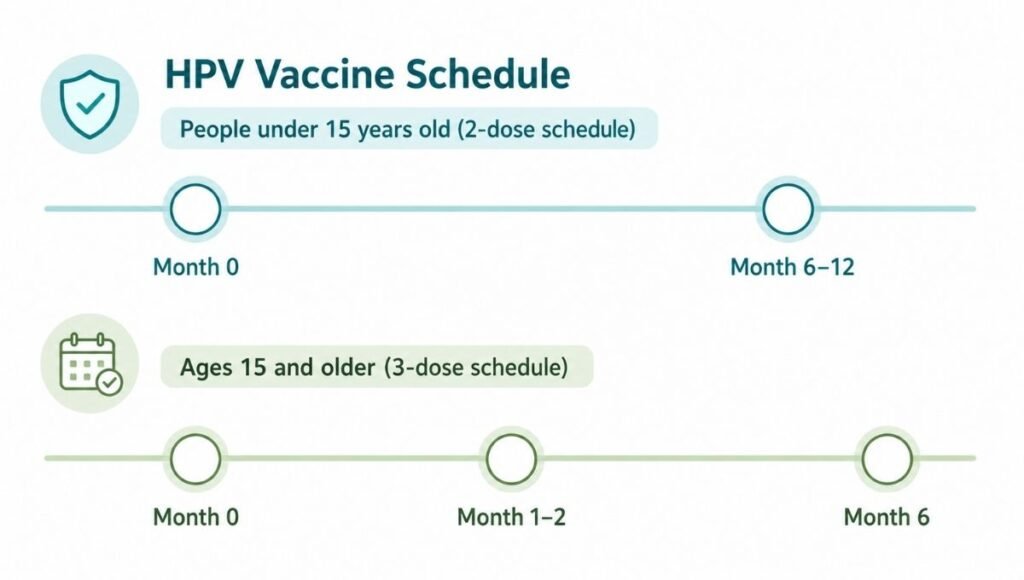
The HPV vaccine schedule is determined by the age at which the series is started — not by whether someone is sexually active, their relationship status, or any other factor. The CDC 2024 recommendations are:
Two-Dose Schedule
Who: People who start the vaccination series before their 15th birthday.
Timing:
- Dose 1: At the chosen start date
- Dose 2: 6–12 months after Dose 1 (minimum interval: 5 months)
Three-Dose Schedule
Who: People who start the series at age 15 or older, and immunocompromised individuals of any age in the recommended range.
Timing:
- Dose 1: At the chosen start date
- Dose 2: 1–2 months after Dose 1 (minimum interval: 4 weeks)
- Dose 3: 6 months after Dose 1 (minimum interval: 12 weeks after Dose 2, 5 months after Dose 1)
Why the difference? Research demonstrated that the immune response to two doses given at the appropriate interval in younger adolescents is non-inferior to the response to three doses in older recipients. The immune system of a younger person who has had less exposure to HPV responds more robustly to the vaccine — meaning fewer doses achieve the same level of protection.
Practical implication: If you are starting the vaccine series at 15 or older — which applies to most adults reading this — you will need three doses over approximately six months.
If you only have 10 minutes: Check whether your primary care provider, sexual health clinic, or pharmacy administers HPV vaccines. In most countries, the vaccine is available without a specialist referral. Booking the first appointment is the only step that matters right now — the schedule will follow from there.
HPV Vaccine Age: Who Should Get It and When
The Recommended Window: Ages 9–26
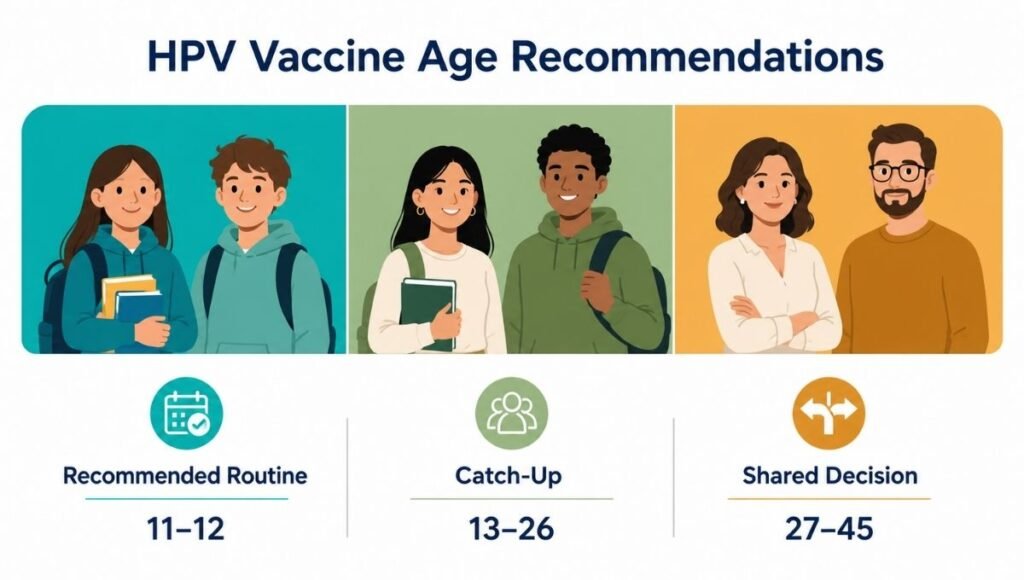
The CDC recommends HPV vaccination for all people aged 9 through 26 who have not been previously vaccinated or have not completed the series. This is the age range in which vaccination is straightforwardly recommended for everyone, regardless of sexual history, relationship status, or perceived risk level.
Ages 11–12 is the target age for routine vaccination — before most people become sexually active and before potential HPV exposure occurs. Earlier vaccination means the immune response is stronger, fewer doses are needed, and the full period of protection is established before exposure.
Ages 13–26 is the catch-up window for anyone who missed the routine vaccination or did not complete the series. Vaccination is recommended for everyone in this group.
HPV Vaccine Over 26: The Nuanced Answer
For adults aged 27–45, the situation is more nuanced — and this is the question that most adults searching for this information are actually asking.
The CDC does not routinely recommend HPV vaccination for adults over 26. The reasoning is probabilistic: most adults in this age group have already been exposed to one or more of the covered HPV strains through sexual activity, and the population-level benefit of vaccinating everyone in this group is lower than for younger people.
However, the CDC explicitly states that adults aged 27–45 may receive the HPV vaccine after a shared clinical decision-making conversation with their provider. The vaccine is not contraindicated in this age group — it is simply not universally recommended.
When vaccination after 26 may still be meaningful:
- Adults who have had limited sexual partners and may not have been exposed to all nine covered strains
- People who were not sexually active until later in adulthood
- Individuals in new relationships after a period of monogamy
- Anyone whose provider, after reviewing individual circumstances, recommends it
The editor’s honest perspective: if you are 27–45, have never had the vaccine, and want it — this is a conversation worth having with your provider. The answer is not automatically “no.” It depends on your individual history and circumstances.
HPV Vaccine for Men: An Often-Overlooked Recommendation
HPV vaccination is recommended for males through age 26 in the same way and on the same schedule as for females. For males aged 27–45, the same shared decision-making framework applies.
HPV causes significant disease in men — including anal cancer, oropharyngeal (throat) cancer, and penile cancer, as well as genital warts. Men who have sex with men are at particularly elevated risk of HPV-related anal cancer and benefit significantly from vaccination.
Despite this, HPV vaccination rates in males remain considerably lower than in females. This reflects a historical framing of HPV as primarily a women’s health issue — a framing that is both clinically inaccurate and has real health consequences.
If you are male and reading this: the vaccine is recommended for you specifically, not only as protection against disease in your own body but because vaccination in any individual reduces transmission — meaning it protects partners as well.
HPV Vaccine Side Effects: What to Expect
The HPV vaccine has a well-established safety profile, with extensive post-licensure surveillance data from hundreds of millions of doses administered globally. Side effects are almost always mild and temporary.
Common side effects (very common — affect most recipients):
- Pain, redness, or swelling at the injection site — typically resolves within 1–2 days
- Headache
- Fatigue on the day of vaccination
- Mild fever
Less common side effects:
- Nausea
- Dizziness or fainting, which can occur in the 15 minutes immediately after vaccination — this is why vaccination providers ask recipients to remain seated for 15 minutes post-injection. It reflects a vasovagal response to the injection itself and is not a reaction to the vaccine components.
Rare and serious adverse events: Anaphylaxis (severe allergic reaction) is a rare but possible response to any vaccine. It typically occurs within minutes of injection, which is why recipients are observed for 15 minutes post-vaccination. Anyone with a known allergy to yeast or to any component of the vaccine should discuss this with their provider before vaccination.
What the evidence shows on long-term safety: Post-licensure safety surveillance — including the Vaccine Adverse Event Reporting System (VAERS) and the Vaccine Safety Datalink — has not found evidence of serious long-term adverse effects associated with HPV vaccination. The safety data is reassuring and extensive.
Does the HPV Vaccine Work If You Are Already Sexually Active
This is one of the most frequently asked questions — and the answer is more nuanced than a simple yes or no.
The vaccine does not treat existing infections. If you are already infected with HPV 16, for example, the vaccine will not clear that infection or reduce disease already caused by it.
The vaccine does protect against strains you have not yet been exposed to. Most sexually active people — even those with multiple partners — have not been infected with all nine strains covered by Gardasil 9. The vaccine provides full protection against whichever covered strains you have not yet encountered.
The benefit decreases with increasing prior exposure, which is the primary reason why vaccination earlier in life provides greater benefit. But the vaccine is not all-or-nothing — even if you have been sexually active for years, there is likely meaningful benefit remaining.
The most accurate answer: being sexually active is not a reason to skip the vaccine. Whether the specific benefit to you as an individual outweighs any considerations is the conversation to have with your provider.
How to Get the HPV Vaccine as an Adult
Primary care provider: The most straightforward route for most adults. Request the vaccine at your next appointment or book specifically for it.
Sexual health clinics: Often offer HPV vaccination alongside STI testing — a practical combination for adults seeking comprehensive sexual health care.
Pharmacies: Many pharmacies in the US, UK, and Australia administer the HPV vaccine without a GP referral. Availability and age eligibility varies by location.
Cost and coverage: In the US, the vaccine is covered by most insurance plans for people in the recommended age range. For adults over 26, coverage varies. In the UK, the NHS provides free HPV vaccination through age 25. In Australia, the National Immunisation Program provides free vaccination through age 25 for males and females.
If you have already had some doses but did not complete the series: You do not need to restart. The series can be completed regardless of the gap between doses — there is no maximum interval that requires starting over.
Warning Signs: When to Seek Attention After Vaccination
The following warrant prompt attention after HPV vaccination:
- Signs of allergic reaction occurring within 15–30 minutes of vaccination: hives, swelling of the face or throat, difficulty breathing, rapid heartbeat, dizziness
- High fever (above 39°C/102°F) developing after vaccination
- Fainting that does not resolve within a few minutes — this is why remaining seated for 15 minutes post-injection is important
- Severe or worsening arm pain, significant redness or swelling at the injection site beyond 48 hours
Mild arm soreness, brief dizziness, and same-day fatigue are expected and do not warrant clinical attention.
Frequently Asked Questions
Who should get the HPV vaccine? The CDC recommends the HPV vaccine for all people aged 9 through 26 — regardless of gender, sexual activity, or relationship status. For adults aged 27–45, vaccination is available but not universally recommended; it should be discussed individually with a provider. Both males and females benefit from vaccination.
How many doses of the HPV vaccine do I need? Two doses if the series is started before age 15 (given 6–12 months apart); three doses if started at age 15 or older (given at 0, 1–2, and 6 months). Immunocompromised individuals require three doses regardless of age at initiation.
Is it too late to get the HPV vaccine if I’m already sexually active? No. Being sexually active does not eliminate the benefit of vaccination. Most sexually active people have not been exposed to all nine strains covered by the vaccine — and vaccination protects against those you have not yet encountered. Vaccination earlier provides greater benefit, but there is no clear cutoff at which the vaccine becomes completely ineffective.
Can you get the HPV vaccine after 26? Adults aged 27–45 can receive the vaccine after discussion with their provider. The CDC does not universally recommend it for this age group because many adults have already been exposed to some covered strains, but it is not contraindicated. Adults with limited prior sexual exposure, those in new relationships, or those whose providers recommend it may benefit.
Does the HPV vaccine prevent all cervical cancers? No — it prevents cancers caused by the HPV strains it covers, which account for approximately 66% of cervical cancers. Regular cervical screening (Pap smear and HPV co-test) remains important even after vaccination, as the vaccine does not protect against all cancer-causing HPV strains.
How long does the HPV vaccine protection last? Follow-up studies from the original clinical trials have found sustained antibody levels and continued efficacy for at least 10–12 years after vaccination, with no evidence of significant waning immunity. Booster doses are not currently recommended.
The Bottom Line
The HPV vaccine is one of the most effective cancer-prevention tools available — and one of the most underutilised in adults who missed the routine adolescent window. If you are under 26 and have not had the vaccine or completed the series, getting it is a straightforward recommendation without qualifications.
If you are over 26 and wondering whether it is worth getting, the answer is not automatically no. It is a conversation worth having with your provider, based on your individual circumstances and history.
The HPV vaccine schedule — two or three doses over six months — is one of the simpler preventive health commitments available. The protection it provides against cancer is about as direct a benefit as preventive medicine offers.
References
- Centers for Disease Control and Prevention. HPV Vaccination: Information for Healthcare Providers. Updated February 2026. https://www.cdc.gov/vaccines/hcp/by-disease/hpv.html
- Centers for Disease Control and Prevention. HPV Vaccine Recommendations. https://www.cdc.gov/hpv/hcp/vaccination-considerations/index.html
- Meites E, et al. Human Papillomavirus Vaccination for Adults: Updated Recommendations of the Advisory Committee on Immunization Practices. MMWR. 2019;68(32):698–702.
- Garland SM, et al. Efficacy and Safety of the 9-Valent HPV Vaccine. New England Journal of Medicine. 2015;372(8):711–723.
- World Health Organization. Human Papillomavirus (HPV) and Cervical Cancer. Updated March 2023. https://www.who.int/news-room/fact-sheets/detail/human-papillomavirus-(hpv)-and-cervical-cancer