
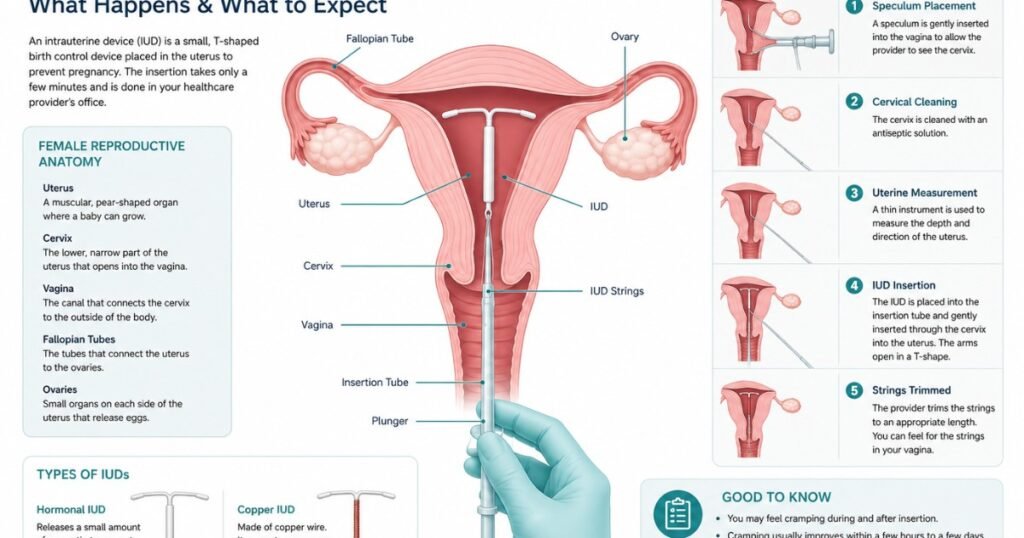
IUD insertion pain is one of the most searched topics about birth control, and for good reason. Ask five people what the procedure felt like, and you might hear five completely different answers. Some describe a few seconds of intense cramping, while others say it was much easier than they expected.
Because every experience is different, it helps to know what actually happens during the procedure and why some people feel more discomfort than others. In this guide, you’ll learn what IUD insertion typically feels like, which part of the procedure is usually the most uncomfortable, what pain relief options are available, and how to prepare for your appointment with confidence.
Quick Answer: What You Need to Know
Before we get into the details, here’s the core picture:
- Pain ranges widely, from mild cramping to brief but intense pain.
- The sharpest discomfort usually lasts only seconds to a couple of minutes, right as the device passes through the cervix.
- Certain factors — never having given birth vaginally, a history of severe menstrual cramps, endometriosis, anxiety, or a sensitive cervix — can make the experience more intense.
- Several evidence-based pain management options exist beyond over-the-counter medication.
- You’re entitled to ask about pain relief and take part in the decision before your appointment.
- Most cramping improves noticeably within hours to a few days.
None of this eliminates uncertainty entirely, but it gives you a realistic starting point — and a sense of what you can actually ask for.
How Painful Is IUD Insertion, Really?
People experience IUD insertion differently, and that’s completely normal. Things like the shape of your uterus, your birth history, your pain tolerance, and even feeling tense before the procedure can all influence how much discomfort you feel.
Why everyone’s experience is different
Cervical sensitivity, the position and angle of the uterus, and pelvic floor tension all play a role in how insertion feels. Anxiety also amplifies pain perception — a well-documented effect across many types of medical procedures, not a sign that the pain isn’t “real.”
What most patients report feeling
Most people describe a moderate cramping sensation, similar to a heavy menstrual cramp, along with a brief sharp pain or pressure at certain points. A smaller share of people experience something more intense and longer-lasting — that’s part of the normal range of responses, not an unusual outlier reaction.
How long the pain usually lasts
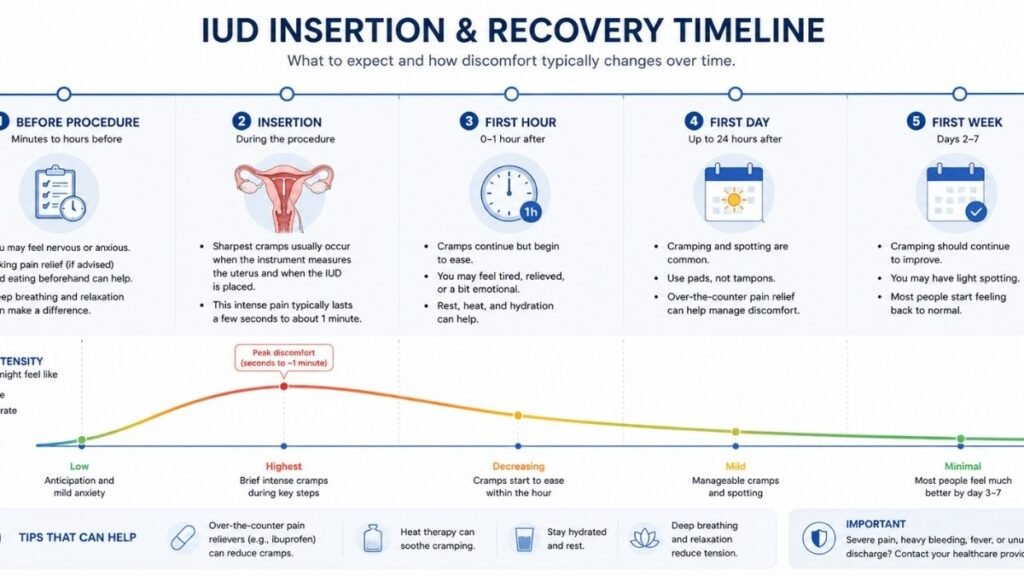
The most intense moment typically happens as the device passes through the internal part of the cervix, lasting a few seconds to about a minute. After that, cramping generally eases over the following minutes to a few hours.
It’s worth keeping in mind that social media tends to spotlight the extremes — either surprisingly easy experiences or unusually painful ones — because those stories get shared more. That’s not a representative picture of the full range, and knowing that can help set a more balanced expectation.
Pain Timeline: Arrival Through Recovery
| Stage | Common Sensation | Approximate Duration |
|---|---|---|
| Speculum placement | Mild pressure, usually little to no pain | A few seconds |
| Cervical cleansing | Slight coolness or mild discomfort | A few seconds |
| Tenaculum placement (if used) | Brief pinch or sharp sensation | A few seconds |
| Uterine sounding (measuring depth) | Moderate to strong cramping | A few seconds to about 10-15 seconds |
| IUD placement | Often the most intense moment overall | Seconds to about a minute |
| Immediately after | Ongoing cramping, similar to period pain | Minutes to half an hour |
| Rest of the day | Cramping gradually eases | A few hours |
Key Takeaway: Pain is highly individual, but knowing what to expect can significantly reduce uncertainty and anxiety going into the appointment.
Which Parts of the Procedure Usually Cause the Most Pain?
Insertion involves several distinct steps, each involving different tissue and a different type of stimulation — which is why the sensations shift throughout the procedure.
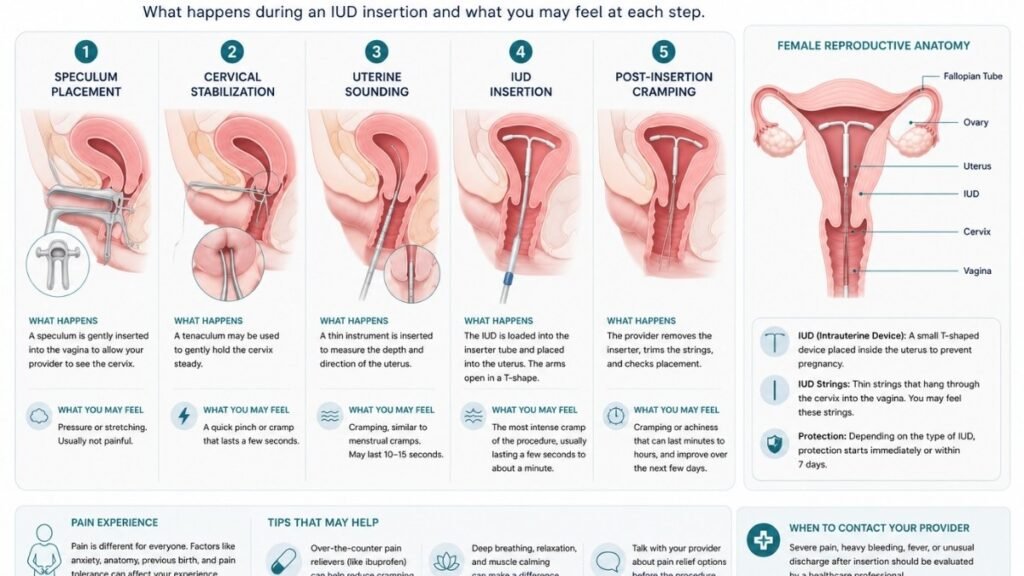
Step 1: Speculum examination
The provider first places a speculum to get a clear view of the cervix. This step is usually more about pressure and tightness than pain.
Step 2: Stabilizing the cervix
To keep the cervix and uterus steady, providers sometimes use an instrument to gently grasp the cervix. This can cause a brief sharp pinch or a quick jolt, though it doesn’t last long.
Step 3: Measuring the uterus
A thin instrument is used to measure the depth of the uterine cavity. This step often produces noticeable cramping, and many people are surprised to find it — not the cervical grip — is the part that catches them off guard. It’s a common misconception that the tenaculum is always the most uncomfortable moment; for many, uterine sounding is just as intense, if not more so.
Step 4: Placing the IUD
The moment the device is released and positioned is typically the sharpest sensation of the whole procedure, though it’s usually very brief.
Step 5: Immediate recovery
After placement, ongoing cramping — similar to a heavier first day of a period — is common and generally starts easing within the following stretch of minutes.
Key Takeaway: Different stages of the procedure produce different sensations, with uterine measurement and insertion often causing the strongest cramping.
To understand how an IUD compares with other options before deciding, see our complete guide to birth control methods.
Who Is More Likely to Experience Significant IUD Insertion Pain?
Understanding risk factors is meant to help you prepare mentally, not to predict exactly how your own insertion will go.
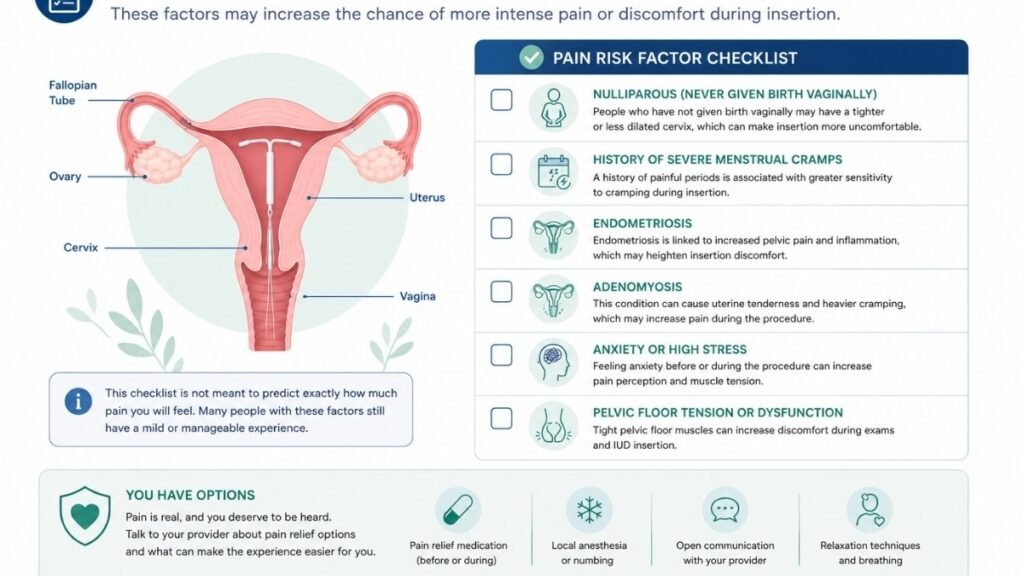
Medical factors
The following are associated with a higher likelihood of stronger discomfort:
- Never having given birth vaginally
- A history of severe menstrual cramps
- Endometriosis
- Adenomyosis
- Cervical or uterine anatomy that’s unusually narrow, tilted, or positioned
Psychological factors
Emotional state also shapes how pain is experienced:
- High anxiety going into the appointment
- Previous difficult or distressing gynecologic exams
- Higher pain expectation beforehand
Chronic pelvic floor tension can also contribute to more discomfort during both the exam and the insertion itself — something worth understanding in the context of pelvic floor tension and cramping.
Does previous childbirth change the experience?
People who’ve had a vaginal delivery often have a cervix that dilates more easily, which can make insertion feel more manageable. But this is a general tendency, not a guarantee — some people with prior vaginal births still find insertion quite uncomfortable, and some who haven’t given birth have a relatively easy experience.
Pain Risk Self-Assessment Checklist
Before your appointment, it can help to check which of these apply to you, and share the results with your provider:
- [ ] I’ve never had a vaginal delivery
- [ ] I typically have significant menstrual cramps
- [ ] I’ve been diagnosed with endometriosis or adenomyosis
- [ ] I tend to feel anxious or tense during pelvic exams
- [ ] I’ve had an uncomfortable or difficult gynecologic exam before
- [ ] I’m currently feeling anxious or worried about this appointment
Checking several boxes doesn’t mean insertion will necessarily be painful — it simply means it’s worth bringing up pain management options proactively when you talk to your provider.
Key Takeaway: Certain medical and personal factors can increase discomfort, but they don’t determine how any one person’s insertion will go.
Pain Relief Options Before and During IUD Insertion
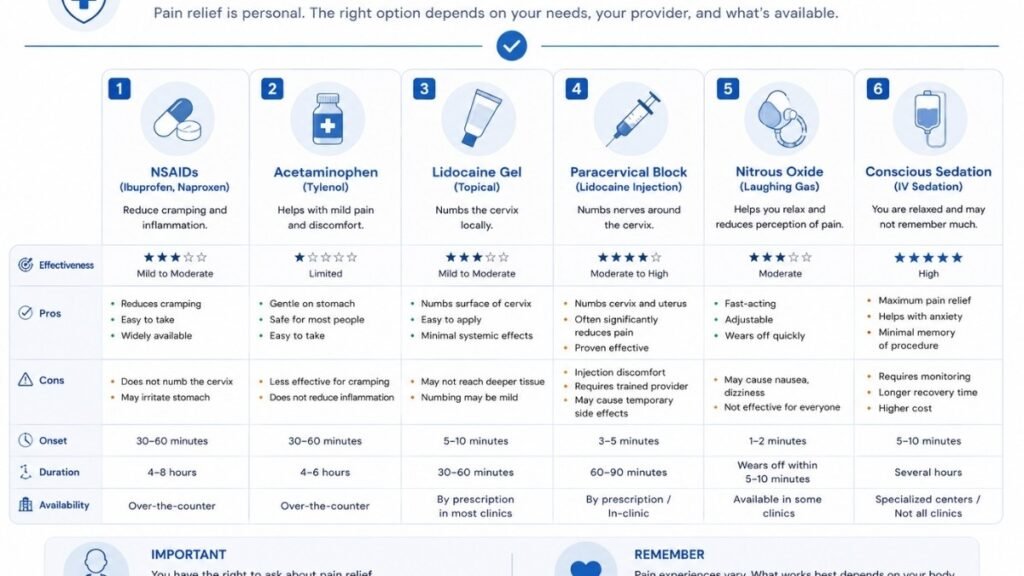
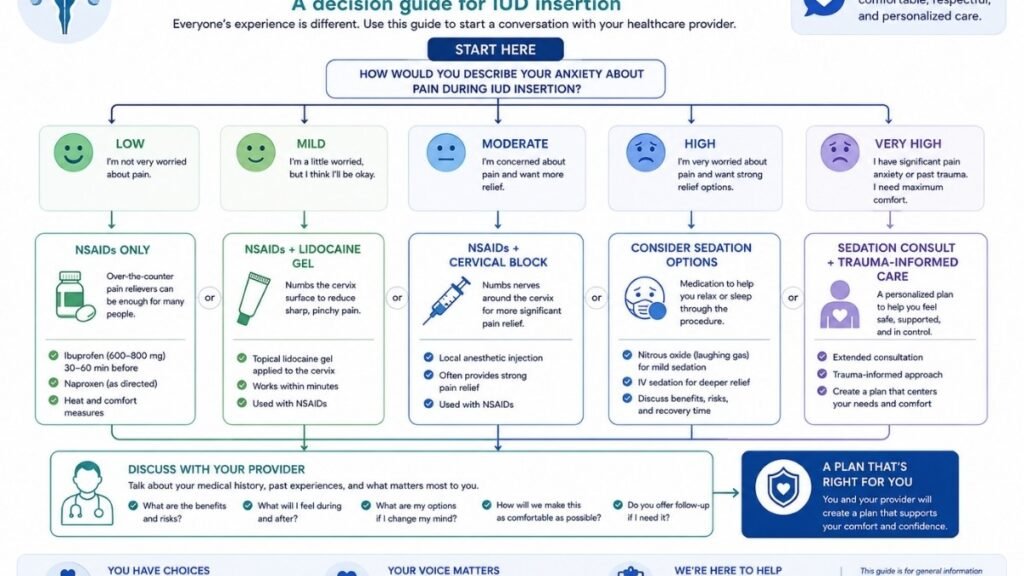
Pain management isn’t limited to “over-the-counter medication or nothing” — there’s a whole spectrum of options that can be matched to your needs and to what a given clinic offers.
Over-the-counter medications
Taking an NSAID (like ibuprofen) a set amount of time before the appointment is the most common and accessible option, and it can help take the edge off cramping. Acetaminophen is another option, though the evidence for its effect on cervix-related pain specifically is more limited.
Local anesthesia
Local anesthesia has become a more common talking point in recent years, and generally includes:
- Lidocaine gel: Applied to the cervix, relatively gentle and simple to administer.
- Paracervical block (injection): An injection that numbs the tissue around the cervix, usually more effective than gel, though the injection itself causes a brief sting.
Sedation options
For people with low pain tolerance, a history of trauma, or significant anxiety, some clinics offer:
- Nitrous oxide: Fast-acting and quick to wear off; you stay awake but more relaxed throughout.
- Conscious sedation: Medication that puts you in a relaxed, drowsy state, usually requiring extra monitoring time and someone to drive you home.
Whether deeper sedation makes sense depends on your medical history, your anxiety level, and what equipment and staffing the clinic has available.
Non-drug comfort measures
Alongside medication, a few other things can help:
- Slow, guided breathing or relaxation techniques
- Emptying your bladder beforehand to reduce added pressure
- Listening to music or a podcast to help with distraction
- Agreeing on a “stop” signal with your provider in advance, so you can pause the procedure if needed
Comparing Pain Management Options
| Option | Onset | Strength | Availability | Best For | Limitations |
|---|---|---|---|---|---|
| Oral NSAIDs | 30-60 min before | Mild reduction in cramping | Widely available at nearly all clinics | Most patients as a baseline | Limited effect on sharp pain from cervical manipulation |
| Lidocaine gel | Within minutes | Mild to moderate | Available at some clinics; ask ahead | Moderate anxiety, want a simple option | Effectiveness varies by individual |
| Paracervical block (injection) | Within minutes | Moderate to strong | Less common, more often at specialty clinics | High anxiety or history of intense pain | The injection itself stings; adds procedure time |
| Nitrous oxide | Almost immediate | Moderate, increases relaxation | Limited; requires specific equipment | Noticeable anxiety without needing deep sedation | Not offered everywhere |
| Conscious sedation | Within minutes | Significant relief | Limited, usually hospital or specialty settings | Severe pain sensitivity or trauma history | Requires monitoring and someone to drive you home |
Availability varies a lot by clinic, so calling ahead to ask “do you offer local anesthesia or sedation options” is a completely reasonable step to take.
Key Takeaway: Pain control isn’t one-size-fits-all, and discussing options before your appointment leads to better preparation.
How to Talk to Your Doctor About Pain Relief and Your Preferences
Clear communication is often what determines whether you actually get the pain management approach that fits you. Providers don’t always bring up every option unprompted, so asking directly tends to get better results.
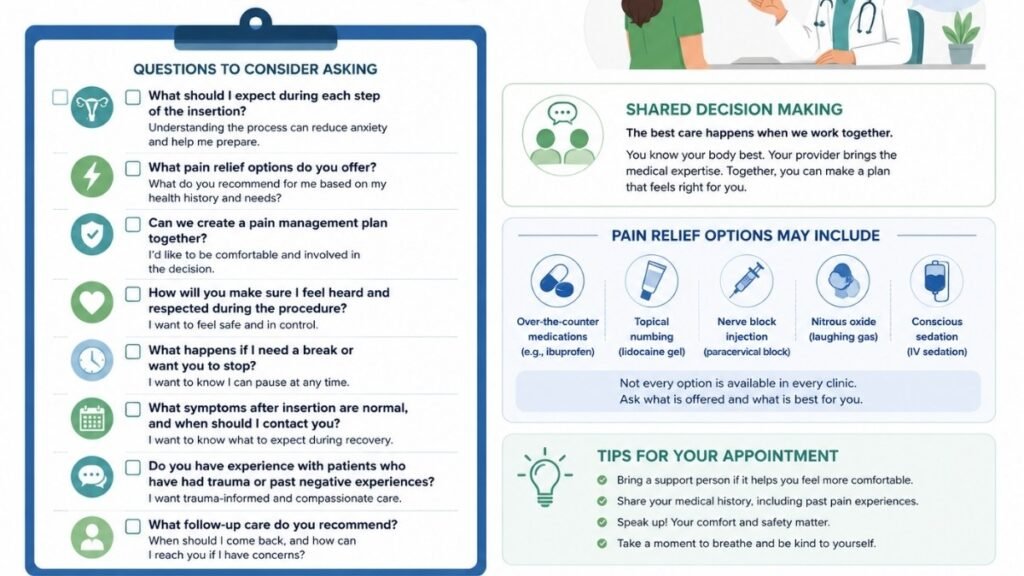
Questions to ask before booking
- Does this clinic offer local anesthesia or sedation options?
- Given my history of severe cramps, do you have any additional recommendations?
- Should I take pain medication beforehand, and if so, what and when?
Questions to ask on procedure day
- Can you tell me before each step what you’re about to do?
- If I need to stop, can we pause the procedure?
- Beyond oral medication, is local anesthesia available today?
A few phrases that can help in the moment: “I tend to get tense during exams — can you walk me through each step as we go?” or “I’d like to use local anesthesia before insertion, is that available today?”
If your concerns are dismissed
If a provider brushes off your concerns or seems impatient, you have the option to:
- Restate your needs clearly
- Ask for a different provider or additional support staff
- End the appointment and reschedule elsewhere
Shared decision-making and trauma-informed care both rest on the idea that your preferences and comfort should be taken seriously — not treated as an inconvenience.
Appointment Communication Checklist
- [ ] Call the clinic ahead of time to confirm local anesthesia or sedation options
- [ ] List relevant history (severe cramps, endometriosis, past difficult exams)
- [ ] Prepare specific questions to ask in person
- [ ] Agree on a “stop” signal in advance
- [ ] Let your provider know you’d like step-by-step narration
Key Takeaway: Clear communication before the procedure increases the likelihood of receiving appropriate comfort measures.
How to Prepare for an IUD Appointment to Reduce Stress and Improve Recovery
Good preparation improves both physical comfort and peace of mind, making the whole experience easier to manage.
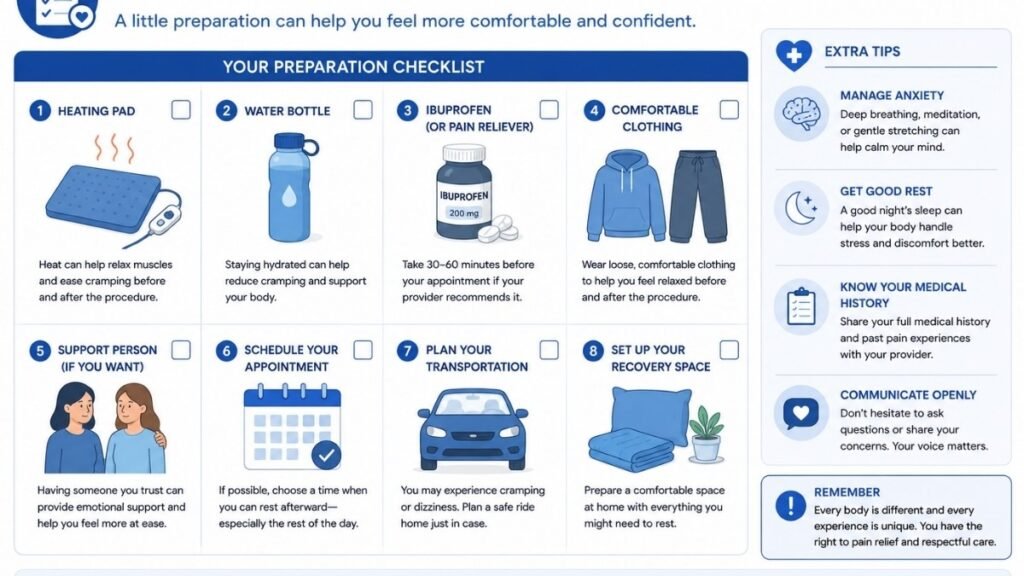
Before the appointment
- Take pain medication as recommended by your provider (usually an NSAID)
- Eat normally and stay hydrated — don’t arrive on an empty stomach
- Wear comfortable, loose-fitting clothing
On appointment day
- Bring a heating pad or reusable heat pack for after the procedure
- Arrange transportation in advance, since some people feel briefly lightheaded or fatigued afterward
- Consider bringing a support person if your anxiety is significant
- Try simple breathing or relaxation techniques to help manage nerves
After the appointment
Many people find that having the rest of the day free — rather than heading straight back to work — makes recovery noticeably smoother. That’s less about anything going wrong and more about giving your body time to settle after the cramping. If your schedule allows it, planning for a half-day or full day off tends to be a practical choice.
Preparation Checklist
- [ ] Take pain medication as directed
- [ ] Eat and stay hydrated beforehand
- [ ] Wear comfortable clothing
- [ ] Bring a heating pad
- [ ] Arrange transportation
- [ ] Decide whether you’d like a support person
- [ ] Keep the rest of the day open for rest
Key Takeaway: Simple preparation can make both the procedure and recovery more manageable.
Recovery After IUD Insertion: What’s Normal and When to Seek Medical Care
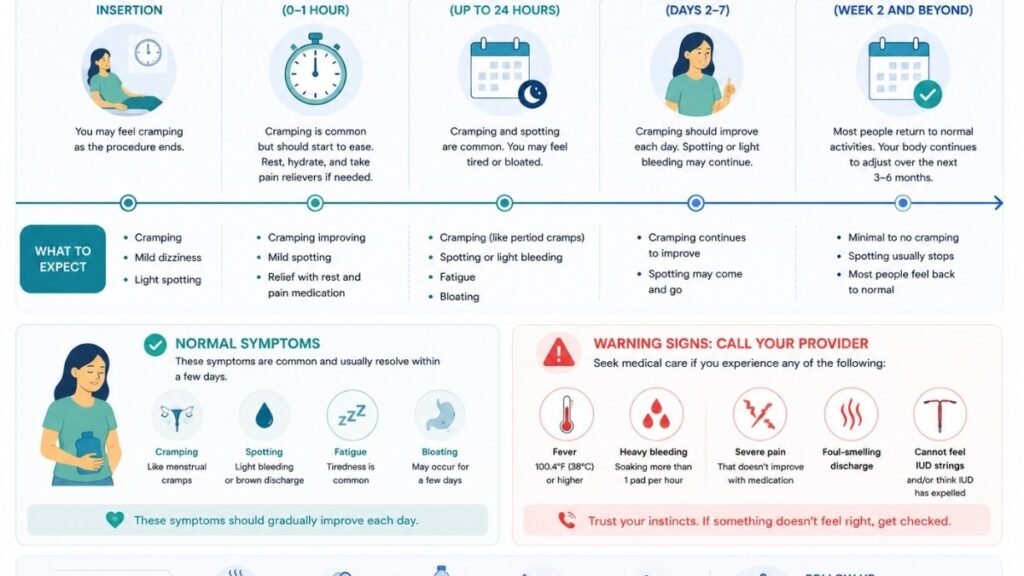
Recovery is usually pretty smooth, but it’s important to know what’s considered normal and what could be a sign that something needs medical attention.
First 24 hours
Mild to moderate cramping — similar to a heavier period — is common on day one. Light spotting or dark discharge is also within the normal range. Some people feel more tired than usual, which is a typical response to the procedure.
First week
Cramping usually eases over a few days, though the timeline varies — some people feel back to normal within a day or two, while others notice mild cramping off and on for one to two weeks. Intermittent spotting can also continue during this stretch.
Most people can return to normal activity, including light exercise, within a day or two, though it’s reasonable to delay more intense workouts if you’re still feeling sore.
Red flags
Contact your provider promptly if you notice:
- Fever
- Bleeding significantly heavier than a normal period
- Severe, worsening pain that isn’t relieved by medication
- Unusual discharge, especially with an odor
- Signs the IUD may have shifted or come out (can’t feel the strings, or the strings feel noticeably different in length)
Recovery Monitoring Checklist
- [ ] Is cramping gradually easing rather than getting worse?
- [ ] Is bleeding within a normal range, not heavier than your period?
- [ ] Is your temperature normal?
- [ ] Can you feel the strings, and do they feel the same length as at insertion?
- [ ] Any unusual discharge or odor?
If any of these red flags show up, it’s worth reaching out to your provider promptly rather than waiting to see if it resolves on its own. For more on what to watch for, see IUD warning signs you shouldn’t ignore.
Key Takeaway: Most symptoms improve quickly, but severe pain, fever, or heavy bleeding should always be evaluated.
Sex, Daily Activities, and Living With an IUD After Insertion
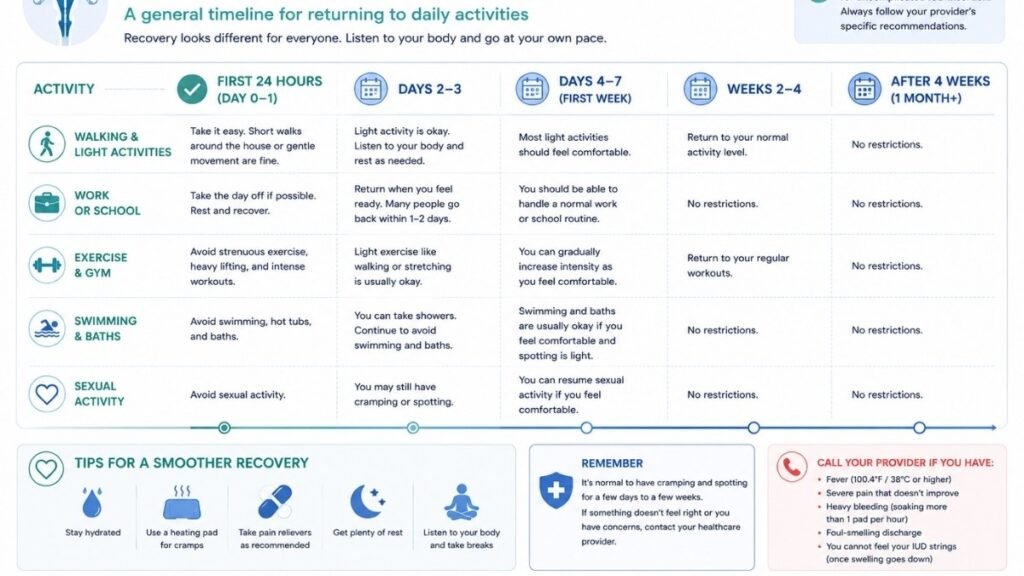
After the procedure, many people wonder when they can have sex again, when the IUD starts working, and whether they need to make any changes to their daily routine.
When is it safe to have sex?
Generally, once you’re feeling physically comfortable and there’s no unusual pain or bleeding, resuming sex is fine. That said, when contraceptive protection actually starts depends on the timing of insertion and the type of IUD, so it’s worth confirming with your provider and using backup protection if needed in the meantime.
Will my partner feel the strings?
The strings are typically soft and usually go unnoticed. If a partner does feel them or finds them uncomfortable, it often just means the strings need to be trimmed slightly — a routine adjustment, not a sign that anything went wrong with placement.
Returning to normal activities
- Exercise: Light activity is usually fine quickly; higher-intensity workouts can be eased back in based on how your body feels.
- Swimming and bathing: Generally no special restrictions.
- Tampons and menstrual cups: Worth checking with your provider first, especially early on — some recommend sticking with pads for the first few days to reduce the chance of accidentally tugging on the strings.
- Follow-up visits: Most providers recommend a check-in a few weeks after insertion to confirm the IUD is positioned correctly.
Post-Insertion Activity Timeline
| Activity | When It’s Typically Okay |
|---|---|
| Sex | Once you feel comfortable — confirm contraceptive protection has started |
| Light exercise (walking, yoga) | Usually the same day or the next |
| High-intensity exercise | Gradually, over the following days, based on comfort |
| Swimming/bathing | Generally no restrictions |
| Tampons/menstrual cups | Check with your provider; pads often recommended initially |
| Follow-up visit | Typically a few weeks after insertion |
Key Takeaway: Most people return to normal activities quickly, with only a few temporary precautions.
Frequently Asked Questions
How painful is IUD insertion really, and what does it actually feel like? Most people experience moderate cramping — similar to a heavy period — along with a brief, sharp sensation right at the moment of placement. A smaller group experiences more intense pain, but that’s part of the normal range rather than a sign that something went wrong. Knowing this range in advance can help you go in with a more realistic expectation.
Why do many doctors downplay the pain associated with IUD placement? This partly comes from how much pain perception varies between individuals, along with a history of pain management not always being discussed proactively in clinical settings. Guidance in this area has been shifting toward encouraging providers to bring up pain options rather than assuming discomfort will be minimal. If you feel your concerns are being minimized, asking specific questions tends to open up a more useful conversation.
What pain management options can I ask my doctor for before getting an IUD? You can ask about NSAID timing recommendations, local anesthesia (lidocaine gel or a paracervical block injection), and whether nitrous oxide or sedation is available. Availability differs significantly between clinics, so it’s worth calling ahead to check.
Is it possible to have an easy or relatively painless IUD insertion? Yes — plenty of people describe only mild discomfort, particularly those who’ve had a vaginal delivery, have a more relaxed cervix, or use appropriate pain management. There’s no way to guarantee this in advance, which is why understanding your options beforehand is still worthwhile.
Is IUD insertion more painful for women with adenomyosis, endometriosis, or severe cramps? These conditions are associated with a higher likelihood of more noticeable pain, but that doesn’t mean severe pain is guaranteed. If any of these apply to you, letting your provider know ahead of time allows for a more tailored pain management plan.
Is it better to schedule an IUD insertion during your period to reduce pain? The cervix tends to be somewhat more open during menstruation, which in theory may make insertion a bit easier, but the evidence isn’t entirely consistent, and timing during your period can bring its own inconveniences. This is worth discussing with your provider rather than treating it as a fixed rule.
What should I do if I feel dizzy, nauseous, or faint during or after IUD insertion? This isn’t unusual and is often related to a vasovagal response. Let the clinical staff know right away, lie down with your legs elevated if possible, breathe slowly, and stay in the office until the feeling passes rather than standing up or leaving right away.
Should I have someone drive me home after getting an IUD inserted? If no sedation was used, most people can safely drive or get home on their own. But if you received sedation beyond nitrous oxide, or you tend to feel lightheaded easily, arranging a ride is the safer choice. Confirming ahead of time what pain management will be used can help you plan transportation accordingly.
🏠 Behind This Guide
Many people worry about IUD insertion pain, but the answers they find are often confusing or one-sided.
That’s why this guide focuses on practical, evidence-based information to help you understand what the procedure feels like, what pain relief options are available, and how to make informed decisions with your healthcare provider.
This guide is built around three essentials:
- 💙 What to Expect — How IUD insertion usually feels and when discomfort is most likely.
- 💊 Pain Relief Options — What may help before, during, and after the procedure.
- 🩺 Recovery & Next Steps — What’s normal afterward and when to contact your provider.
Because the goal isn’t to promise a pain-free experience.
It’s to help you feel informed, prepared, and confident before your appointment.
📚 Related Reading
If you’re exploring your birth control options or want to learn more about sexual health, these guides may also be helpful:
- Birth Control Methods: A Complete Guide to Options, Effectiveness, and Side Effects
Compare different birth control methods, how well they work, and what to expect before choosing one. - Pain During Sex: Causes, When to Seek Help, and Evidence-Based Solutions
Learn about common causes of painful sex, when it’s considered normal, and when it’s time to see a healthcare provider. - Pelvic Floor Dysfunction: Symptoms, Exercises, and How to Strengthen Your Pelvic Floor
Discover how pelvic floor health can affect pain, recovery, and overall pelvic well-being. - Endometriosis Symptoms, Painful Sex, and Sexual Health: A Complete Guide
Understand the symptoms of endometriosis, how it affects daily life, and available treatment options. - How to Communicate in a Relationship: A Practical Guide
Build healthier conversations about intimacy, birth control, and sexual well-being with your partner.
❤️ A Final Note
Good sexual health starts with trusted information and informed choices.
At pureinti, we believe everyone deserves clear, practical, and judgment-free guidance. That’s why every guide is created to help you better understand your body, explore your options, and make confident decisions based on reliable, evidence-based information.
Our goal is simple: helping you make informed sexual health decisions with clarity, confidence, and peace of mind.