
Thinking about ordering an at home chlamydia test often comes with a few immediate questions: What does “at-home” testing actually involve? How accurate is it? How soon after a possible exposure can you test, and what happens after a positive result? Getting clear answers matters, especially since chlamydia often causes no noticeable symptoms and testing options aren’t all the same.
This guide covers the process from start to finish — who should consider testing, how home testing works, what affects accuracy, when timing matters, how to compare your options, and the practical next steps after a positive result.
Quick Answer
- At-home chlamydia testing can mean two different things: a home-collection kit that mails your sample to a laboratory, or a newer test that’s performed entirely at home. It’s worth confirming which type you’re buying.
- Chlamydia often causes no symptoms, so screening recommendations are based on age and risk factors, not just how you feel.
- Reliability depends on the testing method, laboratory quality, sample collection technique, and timing relative to exposure — not simply on where the sample was collected.
- There’s no single “safe” number of days that applies to every test and every exposure. If an exposure was very recent, a negative result may not be reliable yet.
- A positive result should be followed by prompt medical treatment, partner notification, and retesting around three months later, since reinfection is common.
How Does an At-Home Chlamydia Test Actually Work?
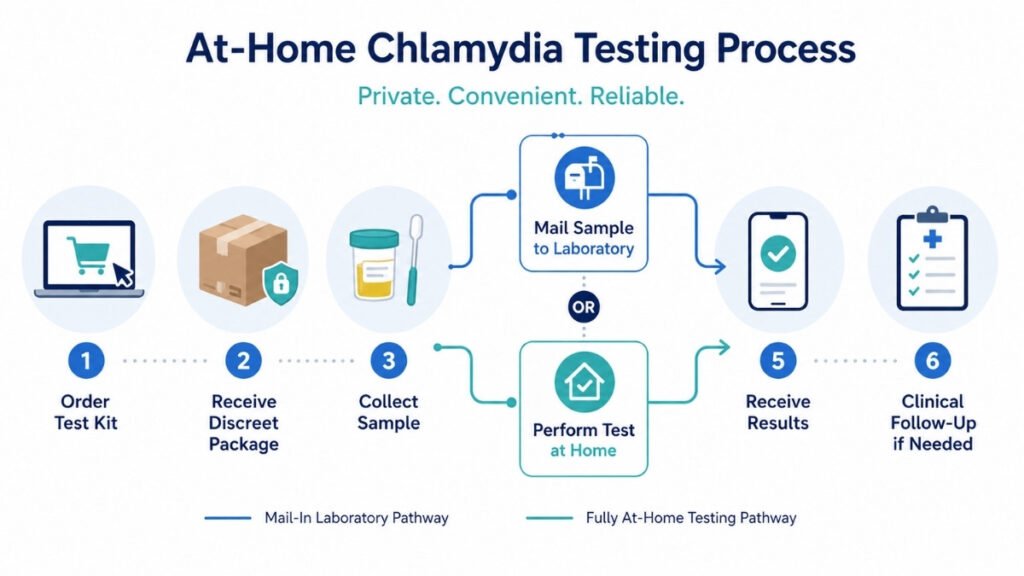
You can collect a sample at home and send it to a lab for testing, or use a newer option that can be completed entirely at home without mailing anything back. The experience differs in how the test is performed, how quickly results are available, and what kind of follow-up support you can access.
Home-collection / mail-in tests
This is still the most common model. You collect a sample at home — typically urine or a vaginal swab — package it as instructed, and mail it to a laboratory. The lab performs the actual analysis, usually using nucleic acid amplification testing (NAAT), and you receive results online, generally within a few days.
Fully at-home tests
A newer category of test allows both collection and analysis to happen at home, with no mail-in step required. In 2025, the FDA authorized the first over-the-counter test of this kind for chlamydia, gonorrhea, and trichomoniasis, using a self-collected vaginal swab that produces a result in about 30 minutes without needing to be sent to a laboratory.
These two models aren’t interchangeable, and product listings don’t always make the distinction obvious. Before ordering, it’s worth checking whether a specific product is a mail-in kit or a fully at-home test, since this affects turnaround time, where your sample data goes, and how the result should be interpreted.
Who Should Get Tested for Chlamydia?
Chlamydia can go unnoticed, so recommendations focus more on your age, sexual history, and recent exposure than on whether anything feels different.
Routine annual screening is generally recommended for:
- Sexually active women under 25
- Women 25 and older with risk factors, such as a new sex partner, multiple partners, or a partner with a known STI
- Men who have sex with men, typically at least annually, and more often depending on individual risk
- Anyone who is pregnant, as part of routine prenatal screening
- Anyone with a new or recent sexual partner, regardless of age
Testing is also reasonable outside of these routine intervals if you’ve had a potential exposure, are experiencing symptoms, or simply want a baseline check before or after a relationship change. If you’re unsure how often you personally should be tested, that’s a reasonable question to bring directly to a healthcare provider, since individual risk factors vary.
Can You Have Chlamydia Without Symptoms?
Yes — and this is central to understanding why routine screening exists in the first place. Chlamydia frequently causes no noticeable symptoms, particularly in its earlier stages. This isn’t unusual or rare; it’s one of the more common patterns with this specific infection, in both men and women.
A chlamydia test can tell you whether the bacteria is present at the specific site sampled, at the time the sample was collected — it’s a snapshot, not a guarantee about future risk, and it doesn’t screen for other infections unless the test specifically includes them.
It helps to think of STI screening the same way you’d think of any other routine health check — a blood pressure reading or a cholesterol panel doesn’t require a symptom to justify checking it, and the same logic applies here. If your risk profile includes exposure to multiple infections, a broader panel may be more appropriate than a single-target chlamydia test.
How Does At-Home Testing Work?
The general process for a mail-in kit looks like this:
- Order the kit, often with the option to add other STI tests to the same order.
- Receive the kit, typically shipped in discreet, unmarked packaging.
- Register the kit, usually by creating an account or linking a unique test code.
- Read the collection instructions carefully before doing anything, since requirements vary by test.
- Collect your sample using the specified method — urine or vaginal swab.
- Store and package the sample according to the kit’s instructions.
- Ship the sample to the designated laboratory, usually via a prepaid mailer.
- Laboratory analysis is performed using a validated testing method.
- Receive your results, typically through a secure online portal, sometimes with clinician review available for positive results.
A fully at-home test skips steps 6–8: after collection, the test itself processes the sample on-site and displays a result directly, without a laboratory step in between.
What Type of Sample Is Used for a Chlamydia Test?
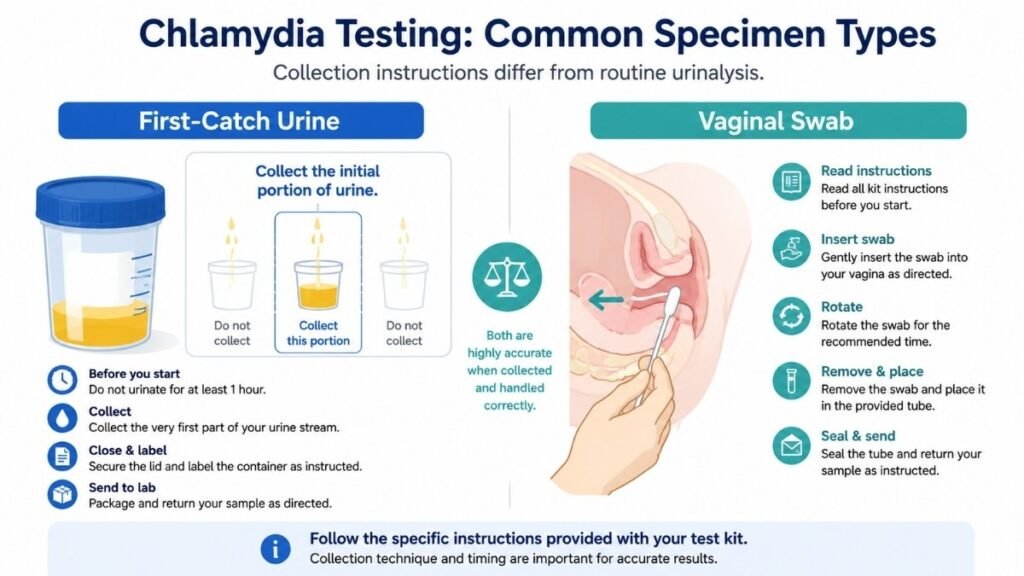
Collection is straightforward, but the details matter — a midstream urine sample, for example, isn’t collected the same way as the first-catch urine used for many chlamydia tests.
First-catch urine
“First-catch” refers to the very first portion of urine passed, ideally after not urinating for at least an hour beforehand. This is different from the midstream collection technique used in a routine urinalysis — for chlamydia testing, the first portion of the stream is what contains the most useful sample material, which is the opposite of what many people assume based on other types of urine tests.
Vaginal swab
A vaginal swab involves gently inserting a swab into the vagina and rotating it as instructed, rather than swabbing externally. Most kits are designed for self-collection with clear step-by-step instructions, since correct depth and technique affect sample adequacy.
When site-specific testing matters
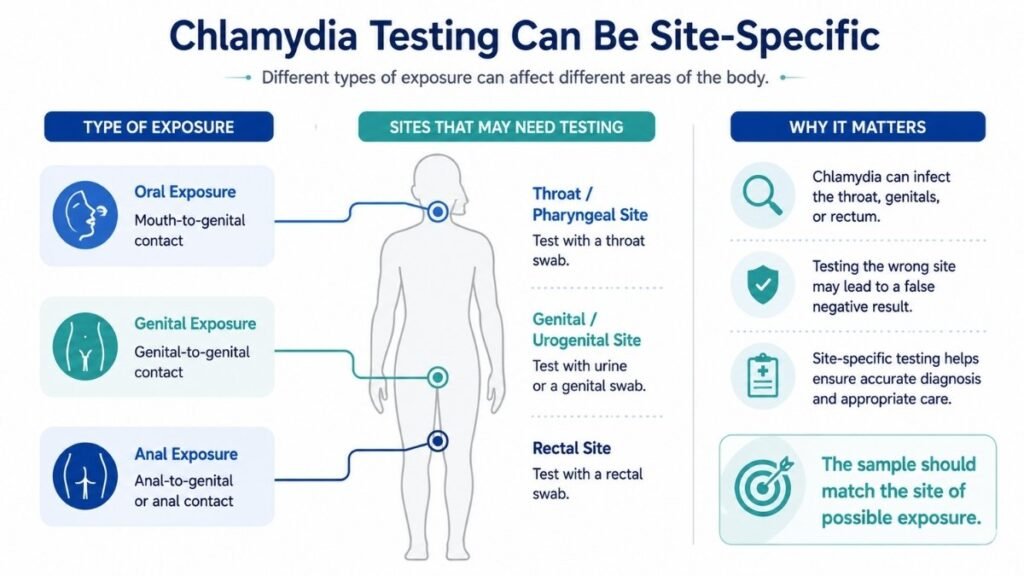
Chlamydia can also infect the throat or rectum, depending on the type of sexual contact involved. A standard urine or vaginal swab test only evaluates the genital tract — it won’t detect infection at other sites. If your exposure involved oral or anal contact, site-specific testing may be necessary, which is worth discussing with a provider or a testing service that offers it.
| Feature | First-Catch Urine | Vaginal Swab |
|---|---|---|
| Typical use | Anyone with a urethra | People with a vagina |
| Collection method | First portion of urine stream, after holding for at least an hour | Gentle insertion and rotation, per kit instructions |
| Common mistake | Using a midstream sample instead of first-catch | Swabbing externally instead of internally |
| Result reliability depends on | Proper timing and technique | Proper depth and technique |
At-Home Sample Collection Checklist
- [ ] Read the full instructions before starting collection
- [ ] For urine samples, confirm you haven’t urinated in at least an hour
- [ ] Collect the first portion of the stream, not a midstream sample
- [ ] For vaginal swabs, insert to the depth specified in the instructions
- [ ] Seal and label the sample exactly as directed
- [ ] Ship promptly if using a mail-in kit, following any storage or timing requirements
One especially common error worth flagging: treating a chlamydia urine test like a standard urinalysis from a routine physical, where midstream collection is the norm. Following the specific instructions in your kit — rather than habits from other tests — is what protects the accuracy of your result.
How Accurate Are At-Home Chlamydia Tests?
Accuracy depends on several factors working together — the testing method, the laboratory’s quality standards (for mail-in tests), and how well the sample itself was collected.
Sensitivity refers to how well a test correctly identifies people who actually have the infection — higher sensitivity means fewer false negatives. Specificity refers to how well a test correctly identifies people who don’t have the infection — higher specificity means fewer false positives.
Laboratory-based NAATs are widely used for chlamydia testing, including with certain FDA-authorized home-collected specimens. How well an individual test performs still depends on the specific assay, specimen type, collection method, and timing — “NAAT-based” alone doesn’t guarantee identical real-world performance across every product.
For mail-in tests, reputable services use CLIA-certified laboratories, a certification that reflects adherence to specific quality standards for clinical testing. It’s also worth understanding what “FDA authorized” means for a given product — this generally refers to the underlying test method or device, not necessarily every claim on a company’s marketing page, so it’s reasonable to look into what a service’s certifications actually cover.
A single “accuracy rate” listed on a marketing page doesn’t tell the whole story. It’s worth distinguishing between the reliability of the testing method itself, which is generally well-established for validated NAATs, and the reliability of any individual result, which also depends on sample quality, timing relative to exposure, and whether collection instructions were followed correctly.
When Should You Test After Exposure?
Timing is one of the most commonly misunderstood parts of STI testing, and there isn’t a single number that applies to every product and every situation.
After a potential exposure, there’s a period — often called the window period — during which an infection may be present but not yet reliably detectable by testing. Testing immediately after a potential exposure, before this window has passed, can produce a negative result even if infection is actually present. This isn’t a flaw in the test; it reflects biological timing that no test can override.
There’s no single “safe” day count that applies across every product and every clinical situation — window periods can vary by test and by individual circumstances, which is why it’s worth checking the specific guidance provided with the test you’re using rather than relying on a generic number. If your exposure was very recent, a negative result shouldn’t be treated as a definitive answer on its own. This is also the FDA’s own guidance for at-home STI tests: even with a negative result, anyone with a recent known or suspected exposure should still follow up with a healthcare professional for further evaluation.
If your exposure risk involves other STIs as well, it’s worth planning a more complete testing approach rather than testing for chlamydia alone, since different infections have different window periods.
Post-Exposure Testing Checklist
- [ ] Note the approximate date of the potential exposure
- [ ] Check the specific window period guidance for the test you’re using
- [ ] Avoid treating an early negative result as a final answer if the exposure was very recent
- [ ] Plan for a repeat test if your initial test falls within the window period
- [ ] Contact a healthcare provider if you have a known or suspected recent exposure, regardless of your result
- [ ] Consider whether testing for other STIs is also appropriate
A negative result must be interpreted alongside the timing of exposure — testing too early cannot be treated as a reliable way to rule out infection, and a recent known exposure warrants follow-up with a provider regardless of the result.
How to Choose the Right Chlamydia Test
Look at how the sample is collected, where it’s tested, how long results take, and what support is available afterward. A little checking before you order can save you from choosing a test that doesn’t fit your needs.
What to look for
- Testing scope: a single chlamydia test versus a broader multi-STI panel
- Test type: a mail-in kit versus a fully at-home test, and which fits your timeline and comfort level
- Testing method and credentials: NAAT-based testing through a CLIA-certified lab (for mail-in tests) or FDA authorization (for fully at-home tests)
- Privacy: discreet packaging and clear privacy policies around how your data is handled
- Turnaround time: minutes for a fully at-home test, versus days for a mail-in kit
- Cost: total out-of-pocket price, and whether HSA/FSA payment is accepted
- Post-result support: whether a positive result includes access to clinician review, a prescription pathway, or a referral for treatment
Single test vs. multi-STI panel
A single-target test makes sense if your exposure risk is well-defined and limited. A broader panel is often more appropriate if you have multiple partners, haven’t been screened in a while, or aren’t fully certain what you may have been exposed to.
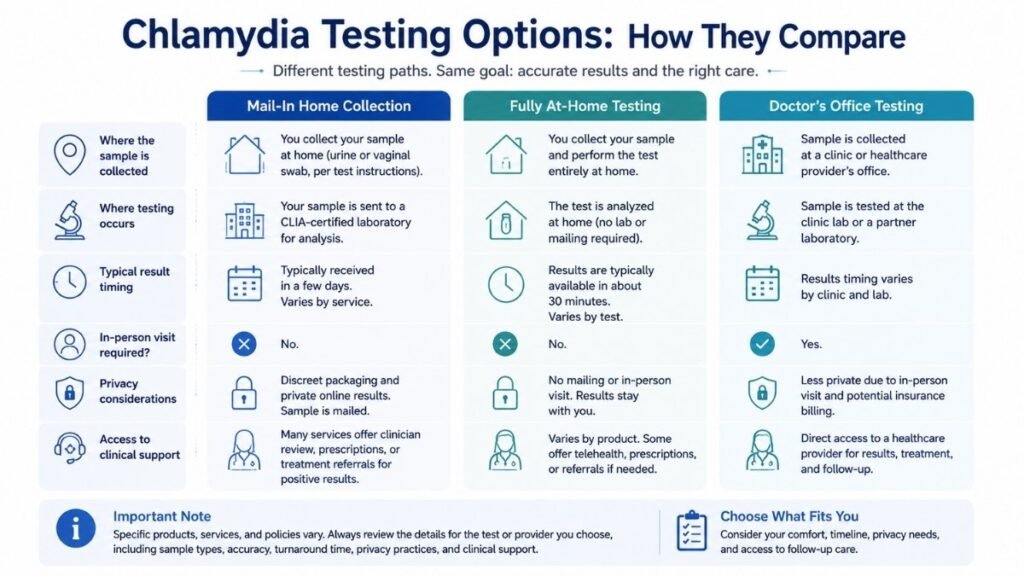
| Feature | Mail-In Kit | Fully At-Home Test | Doctor’s Office |
|---|---|---|---|
| Where testing happens | Laboratory | At home | Clinic or affiliated lab |
| Typical turnaround | A few days | About 30 minutes | Varies by clinic and lab |
| Privacy | High — no in-person visit | High — no visit or mailing | Lower — full clinical visit |
| Cost | Varies; often self-pay | Varies; often self-pay | May be covered by insurance |
| Medical support | Varies by service; some include clinician review | Varies by product | Direct, in-person guidance and same-visit treatment options |
At-Home Test Buying Checklist
- [ ] Confirm whether the product is a mail-in kit or a fully at-home test
- [ ] Confirm the testing method and any relevant lab certification or FDA authorization
- [ ] Check whether the sample type matches your needs
- [ ] Review the privacy policy and packaging details
- [ ] Compare turnaround time across a few options
- [ ] Check total cost, including any additional fees
- [ ] Confirm what support is offered if your result is positive
Rather than choosing based on price or speed alone, it helps to think about your own priorities: someone who wants the fastest possible result may prefer a fully at-home test, while someone who wants built-in clinician support after a positive result may prefer a mail-in service that includes it.
What to Do If You Test Positive
A positive result calls for a clear set of next steps, not panic and not self-management. In order:
- Contact a healthcare provider. Follow the guidance from your testing service, which may include a clinician review or a referral pathway, or reach out to your own doctor or a sexual health clinic directly.
- Start prescribed treatment. Chlamydia is treated with prescription antibiotics, and a provider needs to confirm the appropriate treatment for your situation. Don’t use leftover antibiotics from a previous prescription, since the type, dose, and duration matter for effective treatment. Complete the full course exactly as directed, even if you start to feel fine partway through.
- Tell recent sexual partners. This allows them to get tested and treated, which protects their health and reduces the chance of reinfecting each other. Many testing services and clinics offer resources or anonymous partner notification tools if a direct conversation feels difficult.
- Avoid sex for the recommended period. Follow your clinician’s specific instructions about when it’s safe to resume sexual activity. You should also wait until your recent partner or partners have completed treatment, since an untreated partner is a common source of reinfection.
- Get tested for other STIs when appropriate. Chlamydia often occurs alongside other infections, so your provider may recommend a broader panel if you haven’t already had one.
- Retest in about three months. Repeat infection after treatment is common, largely due to reinfection from an untreated partner, so retesting around the three-month mark is generally recommended even if you feel completely fine.
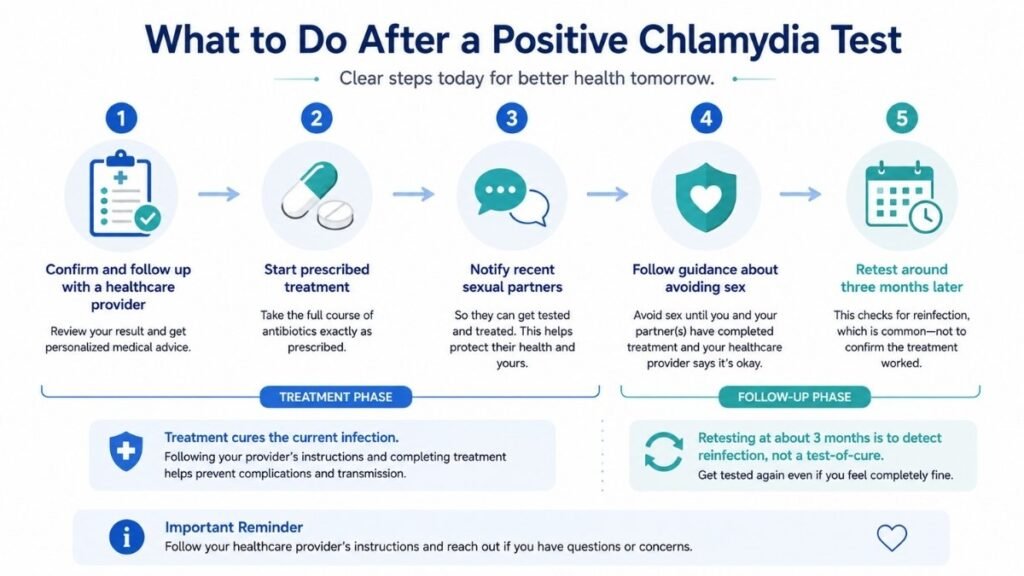
Positive Chlamydia Test Action Checklist
- [ ] Confirm your result through clinical follow-up
- [ ] Get a prescription and treatment plan from a qualified provider
- [ ] Take the full course of antibiotics exactly as prescribed
- [ ] Notify recent sexual partners
- [ ] Avoid sex until your provider says it’s safe and your partner(s) are treated
- [ ] Ask about testing for other STIs if you haven’t had a broader panel recently
- [ ] Schedule a retest for around three months after treatment
A positive result means moving through a standard sequence — treatment, partner notification, a defined waiting period, and a retest around three months later — not a one-time fix.
Frequently Asked Questions
Are at-home chlamydia test kits as accurate as testing done at a doctor’s office? When a mail-in kit uses a validated method like NAAT through a CLIA-certified lab, the underlying testing approach is similar to what’s used in many clinical settings, since both often rely on the same category of laboratory analysis. Performance still depends on the specific assay, specimen type, and how carefully the sample was collected, so following the kit’s instructions matters more with self-collection than it does in a clinic where a provider collects the sample.
How long should I wait after exposure to take an at-home chlamydia test? There isn’t one universal number that applies to every test and every exposure — window periods vary by product, so check the specific guidance included with your test. If your exposure was very recent, a negative result shouldn’t be treated as final, and it’s reasonable to follow up with a healthcare provider regardless of what the test shows.
How do I collect a sample for an at-home chlamydia test? Collection depends on the test type: first-catch urine requires collecting the initial portion of your urine stream after not urinating for at least an hour, while a vaginal swab involves internal insertion and rotation as described in the kit instructions. Following the specific instructions provided with your kit, rather than habits from other medical tests, is essential for a reliable result.
Will my at-home STI test results be shared with my insurance or medical record? This varies by service and depends on how you pay and whether the provider integrates with your existing medical records. Reviewing the specific privacy policy and billing practices of the testing service before ordering is the most reliable way to understand how your results will be handled.
What steps should I take if my at-home chlamydia test comes back positive? Contact a healthcare provider, start the prescribed antibiotic course and complete it fully, notify recent partners, avoid sex until you and your partner(s) have been treated, and plan to retest around three months later, since reinfection is common. Avoid self-treating with leftover medication.
Can an at-home test detect chlamydia if I have no symptoms? Yes. Chlamydia frequently causes no noticeable symptoms, and standard testing methods detect the presence of the bacteria itself rather than relying on symptoms. This is exactly why routine screening based on age and risk factors — rather than waiting for symptoms to appear — is a meaningful part of sexual health maintenance.
How do online same-day STI test orders work compared to mail-in home kits? Online same-day testing typically involves ordering through a website and then visiting a local partner lab for sample collection, with results usually available faster since there’s no mail transit involved. Mail-in kits are collected entirely at home and shipped to a lab, offering more privacy but generally a longer turnaround time; a fully at-home test skips both the mail step and the local-lab visit, producing a result on-site.
What should I do if my doctor refuses to order a comprehensive STI test? It’s reasonable to ask directly what specific tests were ordered and why, since panels can vary based on guidelines, your reported risk factors, or insurance coverage. If you still feel your concerns weren’t fully addressed, seeking a second opinion, visiting a sexual health clinic, or using a reputable at-home testing service that lets you choose a broader panel are all reasonable alternative paths.
🏠 Behind This Guide
This guide was put together to answer the practical questions that come up most often around at-home chlamydia testing — what “at-home” actually means, whether testing applies to you, how reliable it is, when to time it, and exactly what to do with a positive result.
The information here reflects current public health guidance on chlamydia screening, testing methods, and treatment, including the distinction between laboratory-based home-collection kits and newer fully at-home tests. It’s intended to help you understand your options and ask better questions — it is not a substitute for individualized medical advice, and any specific concerns about your results, symptoms, or treatment should go to a qualified healthcare provider.
Sources & Medical References
- Centers for Disease Control and Prevention (CDC) — Chlamydia
- Centers for Disease Control and Prevention (CDC) — Sexually Transmitted Infections Treatment Guidelines
- U.S. Preventive Services Task Force (USPSTF) — Chlamydia and Gonorrhea Screening Recommendations
Related Sexual Health Guides
Want to learn more about STI testing, symptoms, and protecting your sexual health? These guides are a good place to continue:
- Chlamydia Symptoms, Testing, and Treatment — Learn how chlamydia can show up, how testing works, and what treatment usually involves.
- Gonorrhea vs. Chlamydia: Symptoms, Differences and What to Do — Compare two common STIs, including their symptoms, testing, and key differences.
- HIV and Sexual Health — Understand HIV testing, prevention, risk, and the role it plays in routine sexual health care.
- How to Communicate in a Relationship: A Practical Guide — Practical ways to talk about testing, sexual health, boundaries, and other sensitive topics with a partner.
- Sexual Health: A Complete Guide for Adults — Explore the bigger picture of STI prevention, testing, safer sex, relationships, and routine sexual health care.
❤️ A Final Note
Good sexual health starts with trusted information and informed choices.
At pureinti, we believe everyone deserves clear, practical, and judgment-free guidance. That’s why every guide is created to help you better understand your body, explore your options, and make confident decisions based on reliable, evidence-based information.**
Helping you make informed sexual health decisions with clarity